Nearly one in six new cars sold in April was electric, with demand for battery-powered vehicles a clear response to continuing price pain at the petrol bowser. But is our electric vehicle charging infrastructure capable of handling the uptake?
Energy Networks Australia (ENA)—the national industry body representing Australia’s electricity transmission and distribution networks and gas distribution networks—recently submitted a national rule change request to the Australian Energy Market Commission (AEMC) seeking to modernise the framework for EV charging infrastructure and enable faster rollout across the country.
Under the current regulatory framework, access to distribution network installed, owned, and maintained EV charging infrastructure is not recognised as a regulated distribution service. That lack of clarity has slowed deployment, limited scale, and left Australia with an underdeveloped charging network, ENA chief external affairs officer Emma Shanks says.
“Many Australians remain locked out of EV ownership because convenient, everyday charging is unavailable to them—particularly renters, apartment residents, regional communities, and households without off-street parking,” she explains.
“Access to charging is now the critical constraint on EV uptake. This is not a technology gap. It is a regulatory one.”
Related article: Networks request rule change for kerbside EV charging
Networks don’t want to become retailers
Under ENA’s rule change proposal, networks would be allowed to provide shared charging infrastructure at the kerb, particularly where private investment alone is unlikely to deliver timely or affordable access, while ensuring competitive charging providers continue to offer services to customers.
“This is not about networks selling electricity or charging services. Networks don’t want to be retailers. This is about putting the right infrastructure in place so competition can flourish and customers get more choice, better service and lower costs,” Shanks says.
She says DNSPs neither want nor are set up to operate as retailers.
“The driver is getting more EVs—essentially large, mobile batteries—connected to the grid, which can reduce the need for costly network upgrades by soaking up excess rooftop solar during the day.”
Shanks also says it’s important to note that under the ENA’s rule change proposal, DNSPs would have to opt in, with the regulator required to approve each submission on a case-by-case basis.
She says a number of DNSPs have been working on modelling that shows the potential impact of distributor-installed kerbside charging.
“In New South Wales alone, a distributor could install up to 40 kerbside chargers a week, at a cost of around $1.60 to $2.10 per customer per year. That’s less than a litre of petrol,” Shanks says.
There is, of course, concern among energy consumers who fear they’ll be lumped with the bill for infrastructure they may not even utilise.
When news of the proposal hit News Corp Australia’s news.com.au, readers took to the comments section to voice their opinions.
“Why should we pay for their choice?” one reader commented.
“The amount of people who can’t see that it will never be just $1.44 is astounding,” one commenter wrote.
However, Shanks says there are net benefits to consider.
“As uptake grows, better use of existing network assets could place downward pressure on network charges, reducing bills for all customers over time.
“In some cases there might be grant funding from government or a user pays model that allows the costs to be recouped that way but that would be for the regulator to decide.”

Driving EV charging in the regions
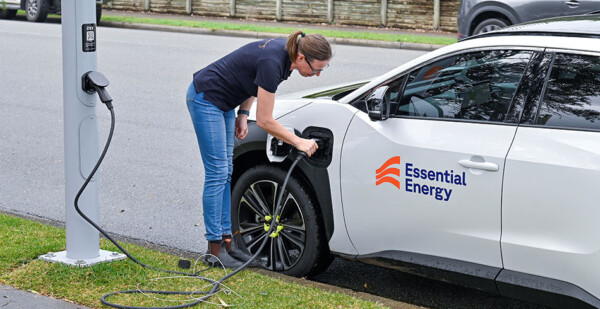
Electricity distributor Essential Energy services more than 900,000 customers across regional, rural, and remote communities throughout New South Wales, and is positioning itself as a catalyst for EV charging in a bid to attract private investment into towns where a sustainable market has yet to emerge.
Through its ARENA-funded Plug and Play EV charging program, Essential Energy will use existing infrastructure to address one of the biggest barriers to regional EV uptake—the high upfront cost and complexity of enabling public chargers in smaller and more dispersed communities.
It has submitted a ring-fencing waiver application to the Australian Energy Regulator (AER) to allow electricity retailers access to 7kW white-labelled chargers installed in 300 composite pole streetlights so they can provide the retail charging services.
Essential Energy general manager commercial development Andrew Hillsdon said, “We know there are a lot of towns where there is no ready-made market but if no-one takes the first step to install the infrastructure and lower the barriers to entry then regional people will continue to lag behind their metropolitan counterparts.
“Essential Energy has the distribution network already with the poles and the wires and it makes sense for us to take this next step to deliver the charging infrastructure that regional people need.
“We have applied for a waiver to create the opportunity for private operators to use their technology with our infrastructure—not so we can operate the chargers.”
The Plug and Play program is specific to kerbside charging infrastructure through two complementary streams:
- Stream 1: Provide 1,000 enabled poles, provisioned with standardised electrical connections for pole mounted chargers, with site selection and stakeholder engagement activities completed by Essential Energy in collaboration with councils. Under this approach, private Charge Point Operators (CPOs) install, own and operate their own charging hardware and deliver all customer facing services, with Essential Energy removing key connection and site facilitation barriers.
- Stream 2: Install 300 composite streetlight columns with integrated chargers, where the integrated charging hardware is procured through an open tender process. Essential Energy will install, own and maintain the chargers while making that infrastructure available to charge point operators under lease arrangements, subject to regulatory approval through a ring-fencing waiver application.
Together, these two streams aim to reduce upfront barriers to scale and speed of kerbside deployment and create more viable pathways for private operators to serve regional and rural communities where the existing process of individual site selection, council engagement, and deployment can be slow and very costly.
In that context, Essential Energy said ENA’s proposed rule change would not replace Plug and Play, but would provide a more scalable, long-term regulatory framework for infrastructure-led, open-access models.
“Essential Energy supports industry reform that enables deployment of electric vehicle charging infrastructure (EVCI) where the pace of infrastructure deployment continues to be a barrier to EV adoption—particularly in regional, rural and remote communities. Regional communities face longer driving distances, lower vehicle volumes, and more challenging commercial conditions, creating a real risk that the EV transition progresses unevenly,” a spokesperson said.
“The opportunity is to use the network we already have to deliver faster, more efficient outcomes for consumers, while bringing the market with us. If the EV transition is to deliver national benefits, it must have national reach. Targeted reform that makes better use of existing infrastructure so that regional and remote communities are not left behind, while preserving competition and supporting efficient investment.
“The proposed ENA rule change approach would not crowd out the market, as the proposal allows for infrastructure to be deployed that can be used by any existing or emerging charging service provider through an open-access model. A framework that maintains open access for service providers and preserves clear separation between network and competitive services can help to accelerate growth in the electric vehicle sector for the benefit of consumers and EV motorists.
“Energy Networks Australia’s proposed rule change, developed with the support of distribution network service providers (DNSPs) across the National Electricity Market represents a coordinated approach to meeting the needs of EV motorists by removing regulatory barriers to DNSP EV charging infrastructure deployment while maintaining competition where it matters most—in the provision of energy supply.”
Related article: Essential Energy set to plug regional, remote EV charging gap
Federal government weighs in
Since the ENA’s rule change proposal, the Department of Climate Change, the Environment, Energy and Water (DCCEEW) has made its own submission to the AEMC, requesting its consideration of a rule change request to support delivery the federal government’s Accelerating EV Charging Program.
The program seeks to identify and leverage the complementary strengths of CPOs and DNSPs to rapidly roll out electric vehicle charging infrastructure (EVCI) and support the creation of a dynamic market that can meet the future needs of Australian EV drivers.
CPOs will be given the first right of refusal to deploy EVCI at sites made ready through the program, with DNSPs acting as ‘providers of last resort’, responsible for deployment at sites CPOs are unwilling or unable to develop at the time of the program. The commerciality of sites is proposed to be re-tested at the end of the program to help support future competition in the EVCI market.
“The proposed program, and this rule change request, is the result of broad consultation across industry, market bodies and state and territory governments. It has been carefully designed to balance the need to accelerate the rollout of EV charging infrastructure to support strong EV uptake, with the desire to preserve market competition and deliver value for Australians, including electricity consumers,” the DCCEEW’s submission read.
“This rule change request seeks to enable DNSPs to add the costs incurred by them under this program to their opening Regulatory Asset Base for the next period, less the amount to be offset by grants … DCCEEW estimates the potential bill impact associated with the program to be minor, peaking at $0.70-$1.44 (depending on the network area), and with no bill impact before 2029.”
At the time of this article’s publication, the AEMC had not yet initiated the aforementioned rule change requests.
Stay tuned for further updates on these proposed electric vehicle charging reforms in Energy Source & Distribution.