New South Wales electricity distributor Essential Energy is positioning itself as a catalyst for electric vehicle (EV) charging in regional, rural, and remote parts of the state in a bid to attract private investment into towns where a sustainable market has yet to emerge.
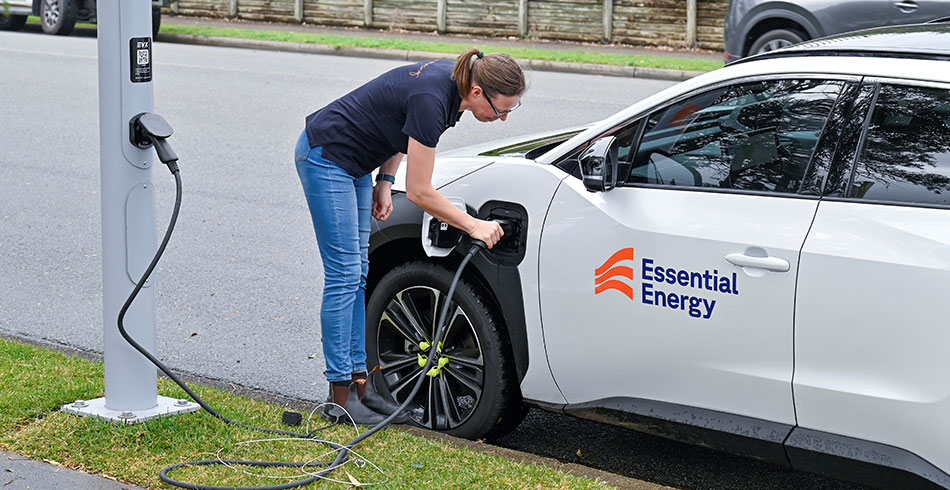
Through its Plug and Play EV charging program, Essential Energy will use existing infrastructure to address one of the biggest barriers to regional EV uptake—the high upfront cost and complexity of enabling public chargers in smaller and more dispersed communities.
Essential Energy is preparing a ring-fencing waiver application to the Australian Energy Regulator for a trial to allow retailers access to 7kW white-labelled chargers installed in 300 composite pole streetlights so they can provide the retail charging services.
Related article: Essential Energy gets regulatory waiver for training academy
While private investment has delivered charging infrastructure in metropolitan areas, the economics remain challenging for areas where usage is low, long distances are involved and the start-up infrastructure costs are high.
Essential Energy general manager commercial development Andrew Hillsdon said, “We know there are a lot of towns where there is no ready-made market but if no-one takes the first step to install the infrastructure and lower the barriers to entry then regional people will continue to lag behind their metropolitan counterparts.
“Essential Energy has the distribution network already with the poles and the wires and it makes sense for us to take this next step to deliver the charging infrastructure that regional people need.
“We are applying for a waiver to create the opportunity for private operators to use their technology with our infrastructure—not so we can operate the chargers.”
Essential Energy will soon submit a ring-fencing waiver application to the AER to allow it to enable private operators to provide services to customers from the charging hardware it will install and maintain.
The proposed program, partially funded by the Australian Renewable Energy Agency (ARENA) under its Driving the Nation Program, will simplify the process for charge point operators by taking care of the infrastructure but allowing private enterprise to plug in their technology and start serving customers.
The Plug and Play trial also includes a second stream of identifying 1000 power poles that can be enabled to more easily allow private operators to install their own charging infrastructure. Unlike providing access to composite pole streetlights, the enablement of power poles for CPOs to install their infrastructure does not require an AER waiver.
Related article: Government plugs $40M into public EV charging network
The ring-fencing waiver application for the composite pole streetlights is time-bound and designed to support a trial that will generate evidence that helps to shape development of the EV charging market and informs future regulatory decisions.
The application reflects a clear separation of roles: Essential Energy does not sell electricity, set charging prices or operate retail services. Instead, the waiver enables the organisation to play a limited, enabling role that improves safety, reliability and coordination while encouraging private investment where it has not occurred to date.