By Phil Kreveld
“Nobody knows the trouble I’ve seen—nobody knows my sorrow,” sang Louis Armstrong.
Of the instrumentalities regulating and operating Australia’s electricity system, the Australian Energy Market Operator is a standout. Of course, it’s not perfect but it is certainly undeserving of uninformed criticism.
Saul Kavonic (Head of Energy Research, MST Marquee), writing in The Australian of 30 April in an op-ed titled Here’s why Snowy dream went south, criticises the Snowy 2.0 project because of the enormous cost overruns. He goes on to comment that “this is a cautionary tale for other government initiatives seeking greater control over energy investment”, and “the ever-expanding Australian Energy Market Operator powers”.
One can only conclude that Kavonic knows close to nothing about AEMO because it is the one and only electrical energy organisation in Australia that knows the troubles of everything that happens in the National Electricity Market, be it in generation, in transmission, in distribution or in operation.
Related article: The canary in the coal mine—retaining grid stability
Nobody knows AEMO’s sorrow
Not many public voices seem to bother about ‘the sorrows’, so to speak, that the technical whizzes at AEMO deal with each and every day—all of this because of the transition to solar, wind, and batteries.
If anything, more powers should be vested in AEMO for the essential reason that it is the only body in Australia with insight into the enormous technical challenges of the renewable transition and with the authority to ensure that the electricity grids of Australia don’t fall over.
When all is said and done, maintenance of voltage and frequency stability 24/7 is the task of AEMO. It might sound simple but it has become very difficult—and there’s no end in sight in regard to further hurdles as more synchronous generation vacates the field in favour of asynchronous, inverter-based generation.
Some have used this ‘technical hurdling’ as the reason for damning renewables. Saul Kavonic is not in that league, of course. He might well agree in that regard with much that a well-known engineering authority, Dr Saul Griffith, espouses regarding electrification through renewable energy.
Australia doesn’t lack other experts in academia, in consulting, and in operations of transmission and generation. However, only AEMO has the reins in its hands—and the awesome responsibility to ensure that things don’t fall apart—a la the Iberian Peninsula grid collapse of 28 April 2025.
AEMO’s problem is that its voice is not heard very often, and when it is, its public messages are massaged so as not to disturb the punters. This is in the nature of large public corporations and organisations, hence this article. Keeping schtum on the trials and tribulations of the energy transition doesn’t serve us in minimising its problems.
Weak grids
So, what are the problems, and are they any different to other countries? We are a standout. Our challenge is dealing with weak grids because of historical reasons, principally existing transmission to remote sites now being used for connecting solar and wind, exacerbated by newer, but long transmission lines to get energy from remote energy zones to our doorstep.
The local advising the newcomer to Ireland who on asking for directions to the capital, is told “that I wouldn’t be starting from here if I wanted to go to Dublin” comes to mind. We are precisely in the same situation as that hapless newcomer. There are those who are in the ‘I told you so’ brigade—essentially wanting to undo the green transition. However, it is very late in the day—and ‘we had better get to Dublin before sundown’.
That means we have to understand the condition and limitations of our national electricity networks—and to let AEMO do its analytical and control of projects work in the national interest. The accompanying graphics, based on torsional springs as mechanical paradigms of Australia’s networks will make clear the technical complexities of attaching any generation, but in particular renewable energy sources. The graphics tell the story as to why AEMO has a complex task. Fortunately, it is well equipped to carry it out.
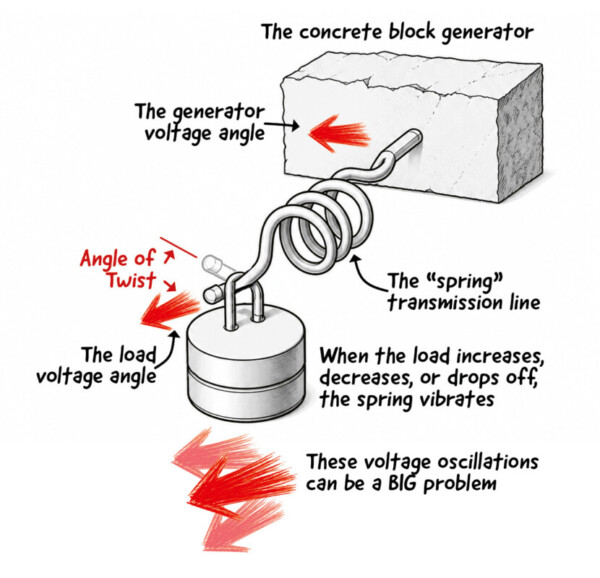
The torsional spring graphics explain a very important concern of AEMO, ‘good vibrations’ and ‘bad vibrations’. These have always been a feature of our electricity systems but are more prominent because of higher frequency patterns—often due to renewable energy sources. The graphics do not explain voltage issues, but good and bad vibrations, however, are like voltage issues, brought about by grid strength problems. In few words, the enormous change from when your correspondent went to tech school to today is that power flow, once so predictable, is now highly variable—and that ‘works the torsional springs much harder’.
Voltage control
Voltage, the mechanical equivalent of pressure, has to stay ‘up’, or the lights dim or go out altogether. Weak springs, in our mechanical paradigm, also suffer voltage weakness. Power flow affects voltage—in general, voltage reduces with power flow increases and the more so in weak networks. Voltage can be ‘pumped up’ without necessarily attaching more generation closer to the locations of energy consumption.
Voltage control is best understood on the basis of reactive power, which unlike active power, does not provide useful energy. Reactive power is ‘consumed’ in long transmission lines, and although this is a bit of an unscientific explanation, voltage control near points of energy consumption is achieved by injecting reactive power so as to keep the voltage up. In practice this is achieved by means of ‘var’ compensators, other static compensators and synchronous condensers. In many respects the Iberian grid collapse was as much due to voltage control problems as anything else. Spain does not have a comparable body to AEMO—we are better off but are not let ‘off the hook’ as to dangers of blackout.
The transition journey has to be tightly managed by AEMO. In doing so it utilises a lot of research, and does its own research utilising the digital twin of the southeastern network of transmission and sub-transmission. The extent of its work in this area deserves another article. For now, we can conclude: (a) that the renewable transition is a major engineering project in its own right; and (b) that AEMO is uniquely qualified in the engineering guidance of organisations and companies involved in delivering services and equipment for Australia’s electricity networks.
Related article: Is the renewables transition in dire straits?
Nobody knows (or seems to care) about AEMO’s troubles
Electrical energy is usually discussed as a bookkeeper’s exercise; energy generated is credited, energy consumed is debited, balances transferred to batteries. Problem is clearing the ledgers—ah well, that’s easy, isn’t it? ‘Clearing the ledgers’ is increasingly problematic because of two-way energy flows, sometimes in bursts, always dynamic—mainly due now to wind and solar. The picture shows a mechanical representation, of just one little piece of a network.
The block of concrete picturing a large synchronous power station is being replaced by much smaller ‘wobblers’, i.e., solar and wind farms. The transmission lines are sometimes strong ‘springs’ but often without much springiness. AEMO’s very challenging job is to keep the whole assembly from shaking off the bookkeeper’s desk.