By Phil Kreveld
Stability in alternating current systems is all-important. It can be though of as a high-wire performance. Slight and heavy wind gusts must be reacted to so as to stay upright and balanced without over-corrective reaction causing a fall. Centralised grid stability control under one roof is necessary.
Australia’s renewables transition is the proverbial ‘canary in the coal mine’ for the rest of the world.
The main reason is our electrically as well as physically long transmission grids. This requires a comprehensive system engineering methodology because of the additional network stability problems posed by renewable, inverter-driven energy sources.
The Integrated System Plan by the Australian Energy Market Operator (AEMO) is not a comprehensive system-wide engineering plan, although it is very important for envisaging the scale of the renewable transition. We are ahead in the queue of emerging instability problems compared to Ireland, Hawaii, California, and Texas. This makes us the object of studies by the Electric Power Research Institute, Energy Systems Integration Group, and the Global Power System Transformation Consortium. The engineering focus of the above-mentioned USA and European research groups is on renewable energy sources’ influence on small and large signal stabilities. They are studying us and learning from our emerging grid instability issues.
Related article: Syncon scenarios and a thought experiment
Long transmission lines and radial topology
The standout ‘canary in the coal mine’ feature is brought about by our long, radial transmission line system. So much of the national discussion is about firming, batteries, inertia, and ‘dunkelflaute’ (absence of wind simultaneously with cloud cover).
These are not distractions but they do not address the underlying stability limitations of the Australian grids. One example receiving some publicity is AEMO’s ‘emergency backstop’ measure. Distribution networks are instructed to switch off domestic and industrial low-voltage solar inverters to maintain grid stability (control of HV transmission line voltage). As power flow in transmission lines reduces, AEMO first calls on gas- and coal-fired power stations to operate their synchronous generators in under-excited mode so as to absorb charging current in long transmission lines.
This also requires the generators to operate near their minimum allowable power operating floor, with potentially harmful effects on the firing system of coal-fired generators. The Iberian Peninsula blackout of 28 April 2025 was in part attributable to the limitations of remaining synchronous generators in the Spanish system to perform the same task. Interestingly, the use of inverters to absorb reactive charging current would be a good solution but would require a non-energy market to be developed.
Many transmission lines, such as EnergyConnect, are as much for power transmission as for providing synchronising torque between distant regions. Synchronising torque is becoming an anachronistic term associated with synchronous generators but the concept also applies to asynchronous generators, i.e., inverters. Our challenge is to preserve synchronicity in the south-eastern grid stretching 5000km and in the south-western interconnected system (SWIS) of 600km. The south-eastern grid is the main challenge.
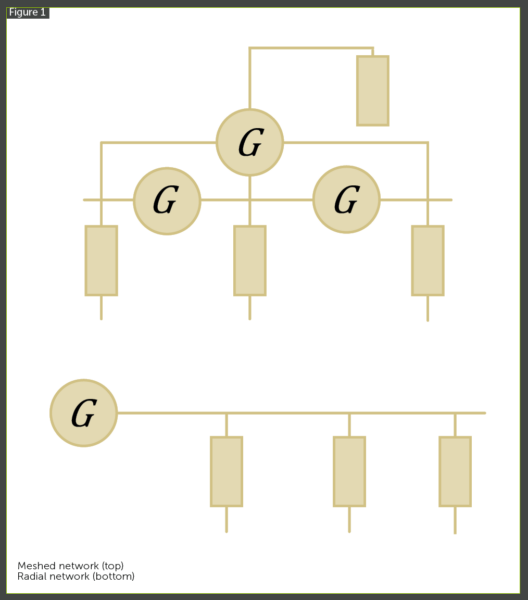
Figure 1 illustrates a radial grid and a meshed grid. A stringy grid connecting high-density population centres along the south-east coast is the reason for Australia’s radial grid topology. It is generally less challenging to maintain synchronicity in meshed grids, although length of lines still is important as the longer the line the weaker the synchronising torque. Alternating current networks if long and radial are a problem from both a stability and control aspect.
To minimise the instability associated with large networks, whether meshed or radial, they are often divided into separate AC regions. There are five in Western Europe, interconnected by direct current (DC) links, thus making each region independent of synchronising torque influence from its neighbours. If synchronisation fails across the grid, protection schemes can break it up into islands. The problem for Australia is to identify self-sustaining islands, because that requires that there be sufficient generation capacity for the island load requirements. Radial grid topology makes islanding rather difficult without load shedding.
A useful mechanical analogy
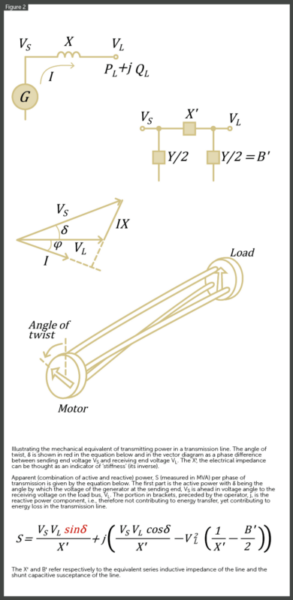
Before examining inverter-based resources’ (IBR) current limitations, consider the properties of a transmission line—particularly a long line. A mechanical analogy is illustrated in Figure 2 (over page). It describes a motor driving a mechanical load using a rather long shaft, connecting them. Instead of a cylindrical shaft, an assembly of three smaller rods held together by discs at either end illustrate the concept of angular twist. As the motor drives the mechanical load it causes the shaft to twist somewhat. The longer the shaft for the same amount of power being transferred from motor to load, the more twist occurs in the shaft. There comes a point when the twist is large enough to break the shaft. An electrical explanation is included in Figure 2.
The mechanical analogy provides important insights into Australia’s particular challenges caused by its long transmission lines and the deployment of IBR instead of synchronous generators. As electrical loads (i.e., energy consumption centres as represented by distribution networks) are distant from many renewable energy zones, the ‘twist’ in the transmission lines enlarge. In electrical terms, the twist is the difference in voltage phase angle at generator terminals and voltage phase angle at the load.
If the twist increases to cause a mechanical breakage, the connection between motor and mechanical load is lost. The identical situation pertains in electrical terms—‘the system has lost synchronicity’. The stiffness of the mechanical shaft, so important in energy transfer from motor to mechanical load, has an electrical equivalent—‘system strength’. Thus, as transmission lines increase in length, system strength declines.
Radial networks with long transmission lines are subject to electrical breakage (loss of synchronicity). Meshed networks, as shown in Figure 1, have generators and loads interspersed—and, importantly, interconnected by so-called tie lines allowing generators to tighten synchronicity by reducing voltage oscillation. Meshed networks are much better equipped to connect IBR.
Related article: Power and reactive power
Unresolved challenges
As coal-fired power stations shut down, they are replaced by large batteries utilising already established transmission links. Fortunately, in many cases those transmission lines to load centres are relatively short (they were constructed by individual state electricity authorities). However, the growth in energy demand is serviced by generation far away from population centres, including the charging of large batteries at former coal-fired power stations.
The synchronicity challenge is caused by two factors: (a) long lines and loss of grid strength, and (b) the use of IBR (whether used in wind or solar, or batteries). Synchronous generators can overcome the lack of ‘stiffness’ by increasing excitation voltage (see Figure 2), i.e., increasing the strength of the rotor magnetic field. IBR use electronic switch-based technology and are therefore much more limited in increasing excitation voltage because of their DC link control limitations. They are also severely current-limited. It is therefore best to deploy IBR in innately high strength works (in electrical terms, ’low impedance’ lines).
There is a certain amount of comfort taken in the successful trials of voltage forming inverters, including virtual synchronous machine (VSM) IBR. However, without trialling in a grid where IBR make up the bulk of energy sources, we are lulled into a false sense of security. A major feature is that their control circuitry is far more responsive, resulting in power and voltage oscillations—more than conventional synchronous machines. We are ahead of metropolitan Spain in the deployment of synchronous condensers that can be operated in conjunction with grid-forming IBR but are as vulnerable because of grid control systems not designed for inverter resources.
Only some of the main challenges have been mentioned. They can be addressed, and some are, but it is no exaggeration that we are still to a very uncomfortable extent short of solutions. The use of synchronous condensers in conjunction with grid-forming IBR is part of overcoming grid strength shortcomings, but in terms of network requirements they represent massive investment. Two very critical matters are (a) new protection schemes for low-strength networks, and (b) centralised grid stability (maintenance of voltage and synchronicity). With regard to the latter, this would appear to be a big factor in the Iberian Peninsula system breakdown last year. For Australia, such a centralised system would be a ‘volte face’—an abrupt change in direction.
In conclusion, we would be best served by a system-wide appraisal and design of a network that presently is subject to the vagaries of individual company and government instrumentality projects. The Australian Energy Market Operator’s Integrated System Plan notwithstanding, there are too many areas that are not addressed as we are bound to experience to our chagrin.