Horizon Power and Synergy are delivering the WA EV Network, Australia’s longest connected electric highway. Energy Source & Distribution goes behind the scenes of this nation-leading project.
Horizon Power and Synergy are rolling out the WA EV network on behalf of the Western Australian State Government as part of its $43.5 million investment in EV infrastructure.
The electric highway is expected to be the longest connected EV charging network in the world when it is completed in coming months.
This innovative project involves the installation of vital EV charging infrastructure around Western Australia to support the uptake of EVs and help reach the state government’s target of net zero carbon emissions by 2050.
The WA EV Network is designed to encourage EV owners to explore the state of Western Australia. Incredibly, the scenic drive has even been mentioned in Time Magazine’s list of ‘World’s Greatest Places 2024’.
Related article: Pacific Energy signs 20-year PPA with Horizon Power

Network specifications
The WA EV Network spans a massive 7,000km, stretching from Mundrabilla, near the South Australian border, to Kununurra in the far north of WA.
It consists of 110 EV fast charging points across 49 locations, with drivers able to top up their vehicles in as little as 20 minutes.
Project challenges
Synergy and Horizon Power are installing EV charging stations along key travel routes, on average 200km apart.
A challenge with the WA EV Network was identifying the most suitable locations for the EV chargers.
Synergy deputy CEO and executive general manager future energy Kurt Baker says, “Synergy worked collaboratively with local shires, businesses, and EV users across Western Australia to identify locations that best suited both the local communities in which the chargers are located and EV drivers.”
When picking locations, EV drivers and accessibility were considered. Consequently, most WA EV Network charging stations are centrally located nearby amenities, including toilets, bins, seating, and shops. A few locations also have drive-through bays in place which allow for towing vehicles to use the chargers.
“EV charging locations were chosen so Western Australians and visitors will be able to access fast-charging stations along major travel routes in the regions, town and city centres, and tourism sites,” Baker says.
The remoteness of some of the selected locations has also proved challenging at times, along with resolving some technical challenges getting the EV chargers to work seamlessly on small microgrids, Horizon Power CEO Stephanie Unwin explains.
“While some of Horizon Power’s chargers are in towns including Broome, Esperance and Exmouth, others are in more remote parts of WA,” she says.
“The remoteness makes logistics and transportation of materials more complex. It also makes it more challenging for repairs and maintenance. Our service area is the largest geographical catchment of any Australian energy provider, so it can take many hours for someone to get to the site to assess and fix a problem.
“Horizon Power is well equipped to meet these challenges. We support the unique needs of some of the most isolated and remote communities in the world and are used to supporting our remote customers, thinking outside the box with innovative technical energy solutions to meet their unique needs.”
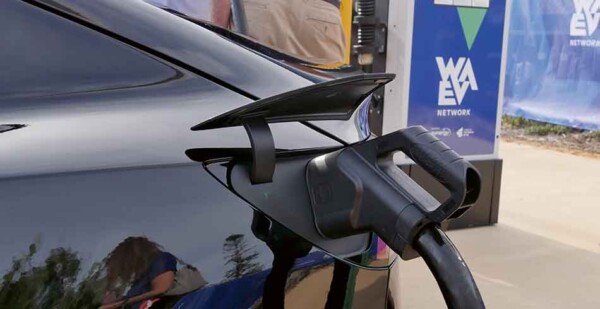
The charging stations
The WA EV Network boasts 110 DC Fast Charger EV charging points across 49 locations, accessible via the Chargefox app.
A critical requirement for the WA EV Network was to have alternative payment options due to remoteness of locations. Nayax provided the contactless payment options at all locations.
Each WA EV Network charging station has at least one EV fast charger unit, capable of charging two cars at the same time, one slower back-up charger (or a second EV fast charger unit), a payment system, lighting and safety bollards.
Horizon Power is installing 58 fast charger points and 25 back-up slower chargers (BYO cable) in 27 locations in regional/remote parts of WA as part of the WA EV Network.
Horizon Power chargers are being delivered across the Kimberley, Pilbara, Mid West and Gascoyne and Esperance/Goldfields regions.
Noting the remote locations for several of the WA EV Network chargers, some of these are supported by a Standalone Power System (SPS). Powered by renewables, the SPS units are enabling EV drivers to access chargers in remote locations, which don’t have an existing power supply.
Horizon Power’s Stephanie Unwin explains, “Some of Horizon Power’s chargers are in remote parts of our state, including at the Pardoo Roadhouse, La Grange and Mueller Ranges. There will also be four charging stations on the Nullarbor, which will support connection into South Australia.”
Synergy is responsible for the delivery of 52 fast charger points and 18 back-up chargers across the state’s main electricity grid, the South West Interconnected System (SWIS), which includes Perth’s metropolitan area and expands from Kalbarri in the north, to Kalgoorlie in the east and Albany in the south.
Synergy’s EV chargers are in 22 locations in WA’s South West regional centres and Perth city, including Kings Park.
Synergy’s Kurt Baker says, “So far more than 25,000 charges have occurred via WA EV Network charging stations, with drivers charging their car in 32 minutes on average.”
Related article: Synergy gets approval for 500MW/2GWh Collie Battery

The feedback so far
The response to the WA EV Network has been positive, with the network making it easier for EV drivers to explore Western Australia and connect with the rest of Australia.
Synergy’s Kurt Baker says, “We have celebrated with local communities as we opened new chargers in each region and communities have been positive about the project and how it will support a new wave of tourists to their towns.”
Horizon Power’s Stephanie Unwin says, “It is exciting to hear how the WA EV Network is helping EV drivers to explore our wonderful state. This includes following the adventures of a Perth family on their epic trip around Australia in an EV, towing a pop-up caravan, as well as another Western Australian who became the first person to drive an EV truck around the country.
“We are grateful for these EV pioneers and the feedback and assistance they give us is a huge help in making the network as user friendly as possible. As we near completion of the project we look forward to continuing to work with them to make the network a success.”