It’s a tough life for a power pole in Queensland—between wild storms, cyclones, floods and bushfires, there’s termites and rot to contend with, along with extremes of temperature.
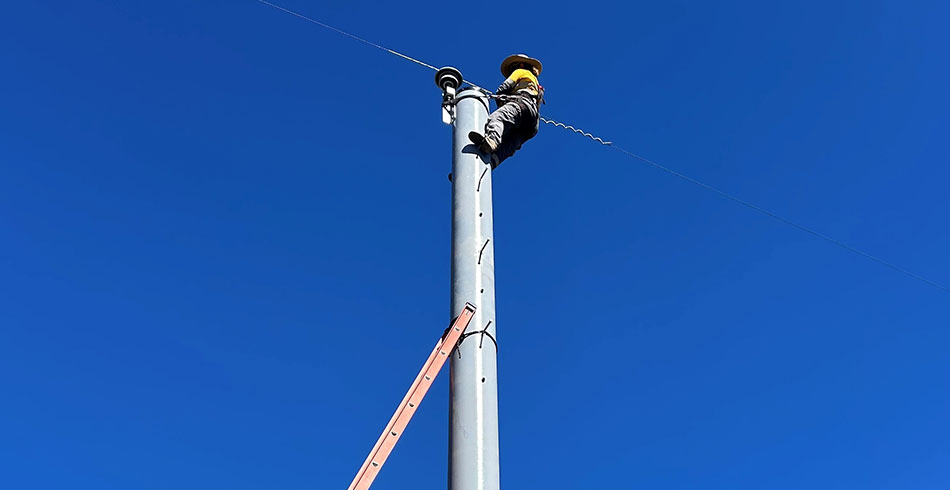
That’s where composite poles are showing promise as a durable, cost-effective, highly functional alternative. After a successful seven-month trial of fibreglass-reinforced polymer poles at sites across the state, Energy Queensland is planning to expand the pilot into more locations and operating environments.
“We’ve been trialling the composites in diverse conditions, from our semi-rural network in South-East Queensland to blacksoil plains across the Darling and Western Downs, up on the Atherton Tableland, and around Townsville and Rockhampton,” principal engineer overhead standards Fabio Zaini explains.
Related article: Fireproof mesh to be installed on power poles in Qld
“We’re not just looking at how they function on different parts of our network and under varying weather conditions, but also how our crews find them to work with and what equipment works best with them.”
Energy Queensland’s distribution companies, Ergon Energy Network and Energex, are responsible for 1.7 million poles across the state, supporting more than 200,000km of network stretching from the wet tropics to the outback to densely populated urban centres.
The poles being trialled are proudly Australian-made and tick a lot of boxes. They are not affected by rot or termites, and extensive testing has indicated that the composite models are more resistant to bushfire damage than their hardwood counterparts. They are also less susceptible to extreme damage from lighting strikes.
A key advantage is weight: composite poles tip the scales at around 300-500kg, substantially less than timber poles.
“This is a particularly important factor for storm response,” Zaini says.

“Crews often encounter situations where storms or lightning strikes have demolished an existing pole, but heavy mud makes it very difficult to get a traditional timber replacement pole to site. There’s some great potential for composites as part of storm response, as they’re able to be transported to site, even in very wet conditions, via a Polaris ATV.”
The lighter weight also translates to substantial reductions in transport costs, particularly to more remote locations, as many more composite poles can be carried on each truck.
Standing the composite poles is also quicker, and safer. They come predrilled to Energy Queensland’s specs, cutting down the time needed to dress the poles while also reducing crews’ exposure to potential safety hazards associated with dressing. Importantly, feedback from teams who have worked with the composite poles in the field has been overwhelmingly positive.
“No matter how good a solution might appear on paper, it needs to be feasible for our teams in the field: safe, efficient and effective,” Zaini says.
“It’s been really heartening to see how well received the composite options have been, and we’ll be continuing to seek feedback and insights from crews working with these models in a range of applications and environments.”
Based on initial trial findings, the composite poles are cost effective. While they are more expensive initially compared to the current costs of traditional timber poles, the fibreglass-reinforced models are quicker to install, and are expected to be more durable and require less repair and maintenance over their 70- to 80-year operational lifespan; well and truly recouping the initial cost difference.
Related article: South Australia’s iconic Stobie pole celebrates a century
Energy Queensland is now preparing to expand the trial to another 1,000 poles on rural lines and suburban networks across Queensland over the next six to 12 months.
“This will put the poles to the test in a broader range of terrain, load and climate conditions, and help identify which environments they’re most suited to,” Zaini says.
“We’re also finalising design work on how the composites work with strains, terminations and stay wires to expand their use in the future. Ultimately, the goal is to understand what are the best fit-for-purpose options which can help maintain the delivery of affordable, reliable and safe electricity to Queenslanders, for decades to come.”