By Phil Kreveld
A message for all those concerned about reliable electricity—and not just for the engineers.
Our national problem is that the political debates have hijacked sensible engineering solutions—and—the tight corset imposed by the regulators likewise force very, very expensive transmission voltage stability controls—all at the cost of the punters.
The challenge provided by the increase in renewable generation is that we are missing the bus—that is, the infinite bus. Grid strength, an electrical engineering concept, has entered everyday language. Not so, the infinite bus. The infinite bus coupled to high grid strength transmission lines provides the basis for highly stable, resilient networks.
You might well at this stage read no further because some dry engineering language is about to follow. But please bear with me, because even if some concepts discussed further down are not clear, the central message is the vital one to keeping the lights on.
Keeping the lights on is usually discussed around having enough wind and solar but also batteries—and gas, or even coal-fired generation. That’s all about energy source security—and it is important. But there’s something equally serious—something that doesn’t rate a mention in the popular media—and is very much affected by the renewable energy transition. Hence the perhaps curious title of this article.
Related article: King Cnut and the solar tides
The takeaway message is that quite apart from having enough sunlight, wind and battery storage for energy, the newer renewable technologies when compared to the traditional power stations from our childhood are forcing new engineering concepts to be applied—in order to keep the lights on.
If you wish an encapsulation, rather than following the rest of the technical arguments, here it is: The national electricity system of long transmission lines is not suited for distant solar and wind farms. The long transmission lines are a consequence of scattered population centres. The closure of coal-fired power stations has exacerbated the deficiencies of the transmission line system. To stress this again: it’s not about energy—it is about the electrical engineering complexity and the very high costs associated with transmission remediation.
Grid failures are the stuff of screaming headlines—like the one in Spain last year, or back in 2016 when South Australia went dark. Because the underlying reasons were complex, the take-out message for both was to blame it on ‘renewables’. Never mind the real reasons because that just gets too involved. And since keeping the lights on is so vital to our population and the national economy, some important engineering concepts are explained here.
Before we launch into some engineering concepts, let’s agree on the essential item—voltage! It’s the equivalent of water pressure. Provided your premises have the required voltage, you’re fine—never mind installations elsewhere—your machines run and your lights are on—never mind where the electrons came from. It’s always voltage, voltage, voltage—nice and stable.
That is where the infinite bus comes in. Think of the infinite bus as the source of stable voltages everywhere—all the time. However, the infinite bus has departed without us—and it’s not coming back. We have to make do without it—and the Australian Energy Market Operator (AEMO) is tasked with making things work notwithstanding its absence.
The infinite bus is a theoretical concept, and the national electricity market is a real thing—not run on theoretical concepts. Nevertheless, the infinite bus is a very useful concept in designing and maintaining stable and reliable electricity systems for Australia. Being a vast country with relatively few coal-fired and gas-fired generation, even before solar and wind entered the scene, we had something approaching ‘infinite buses’ but only rather imperfectly. Retiring coal and gas generation has seen the concept becoming a thing of the past.
The accompanying sketch illustrates the concept in (a). First-year electrical engineering students draw these diagrams in their notebooks. On the left is the source of voltage (some kind of a generator—any old thing). On the right is an electrical load (consuming electrical energy). Connecting the two is a wire—the transmission line in the real world. The generator is a perfect one—it supplies constant voltage and frequency, no matter what you hang off the end of it—there is your infinite bus, but it resides in a notebook.
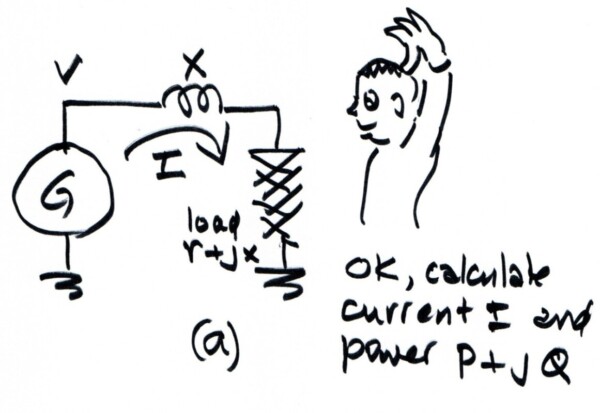
Coming back to reality, we know that there are no perfect anythings—and no perfect generators either. So, why worry about theoretical concepts. In short, to back up the theory taught to electrical engineering students in a world of only synchronous generators, it was almost possible. In the real world it made for orderly control of large, widely spread networks. Mind you, it took a lot of embarrassing grid collapses to figure things out.
In the real-world circles in (b) representing generators behaved themselves beautifully. Interconnected generators with tie lines between them provided an infinite bus as near as damn it. You could almost hang anything by way of loads or long transmission line on points on the dotted line and rely on constant voltage and frequency at their input terminals.
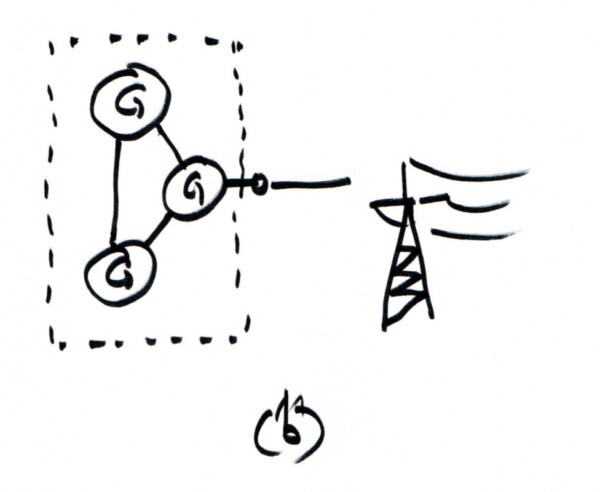
But as indicated, those days have gone for good. As more and more wind and solar inverter-based resources take over, the more unstable things become, voltage and frequency-wise. Even though battery energy storage system-connected inverters are made out to be the equivalent of synchronous generators, they are not. That is not to say that no stable electricity system can be built with them—but it is fiendishly more complicated.
This in spite of protestations from inverter manufacturers that they have completely copied the old-fashioned synchronous generators. Neither AEMO nor transmission grid companies take them at their word. The solution is in backing these inverters with synchronous condensers. And even so the great stability advantages of the infinite bus, supported by synchronous generators cannot be mimicked.
To make life even more complicated, the transmission networks are being extended by hundreds of kilometres thus making life much more interesting as to the maintenance of voltage and frequency stability. Short circuit current to operate circuit breakers is compromised, ride-through of large loads such as data centres, equally. The absence of our erstwhile fairly solid infinite bus is having us invest in hundreds of millions of dollars in transmission grid stabilisation. But even so, the absence of rock-solid voltage and frequency requires new control systems that are by no means tried and true.
Were we to employ more ‘clean’ synchronous generation instead inverter resources then, although perhaps more widely spread throughout the southeastern grid, voltage and frequency stability as well as fault current to operate circuit breakers would be available. Our national electricity system would have much better voltage stability—and we could still have clean energy.
These pages here aren’t big enough to lay out the southeastern grid. There are some 3000 major connection points (buses). Generation and load centres connect to them. Some are terminal stations—as the name implies, the end of the road for transmission lines. From there the energy goes to distribution networks—and to all those households and businesses with rooftop solar.
To replace the infinite bus, we resort to basketfuls of minibuses. These are combo synchronous generators-synchronous condensers. To be clear it’s just one machine providing both functions alternately. In the daytime, with Mr and Mrs Kerfoops’ solar system cranking out lots of watts, it’s the syncon function keeping the voltage nice and stable. But what happens at sundown? The syncon now becomes the generator topping up the Kerfoops’s battery—and helping out with the roast. But hang on—where did the energy come from to run the machine as a generator? Stored heat in graphite blocks—during the day from all that solar energy being generated on rooftops—and turned into steam or to heat carbon dioxide for the generator turbine.
Related article: Renewables vs fossil fuels: Why can’t we walk and chew gum at the same time?
But wait, there’s more.
A huge, huge problem for AEMO is unloaded transmission lines and with more and more rooftop solar, the problem is getting bigger. Transmission lines are not extension cords—they are a pesky, complicated thing. If they don’t carry enough power, their voltage rises dangerously—if too much, voltage drops alarmingly. The daytime voltage rise which AEMO has difficulty in controlling can be remedied now. The graphite blocks mentioned above absorb power from the Kerfoops’ solar system and from the transmission line so as to keep that voltage within acceptable limits. In short—the infinite bus has gone—never to return but the minibuses provide stable voltage and reliable power when needed. And it’s done with synchronous machines—far more predictable in performance than the much vaunted ‘firming’ and ‘forming’ inverters.
And finally, our national problem is that the political debates have hijacked sensible engineering solutions and the tight ‘corset’ imposed by the regulators likewise force very, very expensive transmission voltage stability controls—all at the cost of the punters.