By Phil Kreveld
Criticism comes easily—fixes don’t. The nation’s electricity system is a frequent target. Some ‘fixes’, if not simply stirring the pot, pick on a technology.
Renewables; bad/good; coal bad/good; gas bad/good; nuclear bad/good; and, for good measure, climate change; nonsense/calamitous. If only it was simply making a choice here.
How we now deploy generators, transmission lines, and distribution networks goes back to 1994, the year of the Commonwealth Government’s Hilmer Report. It gave consumers of electrical energy the ‘Power of Choice’, gave governments the opportunity to sell off electricity assets, and saw the birth of the electricity regulatory authorities, which were necessary to ensure oligarchs and monopolists in electricity didn’t rip off the punters.
Politically, electrical energy is exploited to benefit parties. At best, it makes for shouting matches at or near election time; at worst it scares off money looking for electricity projects. Politically it is dividing cities and the environmentalists—transmission lines good/bad, renewable energy zones good/bad. Renewables left wing, coal and gas right wing.
All this makes for exploitation of the ‘flavour de jour’, be it transmission, wind, solar, gas, or coal-fired generation on life-support and the necessary engineering solutions at whatever cost. As a solace, it may well be that infrastructure planning has always been ad hoc—and electrical infrastructure is no exception.
Related article: In defense of AEMO and its sorrows
Guaranteed returns on new poles and wires give life to new investment, yielding perpetuation of last century’s engineering. Alternatives are not investigated—not even the obvious ones, outlined further down.
The biggest challenge of the national electricity system is highly variable power flow. Not that it gets a guernsey. Energy economists we have aplenty. They are focussed on $/megawatt-hour—and that’s also what fills op-eds in the media. The ‘cardigans’, far away from the corner offices, fret about the megawatts, and in particular how those megawatts go up and down—rapidly!
At the turn of the century power flow in transmission lines was much more predictable than now. Highly variable power flow causes massive investment on top of transmission line costs. Everyone knows the reason for the variation throughout the day—it’s rooftop solar. Not only rooftop, of course, because big solar and wind are none too steady. Hardly anyone outside of the ‘cardigans’ appreciates why that additional investment is costly as well as urgent.
The longer the distances between using up the energy and generating it the more costly investment in augmentation becomes. Voltage and frequency control get to be really complicated—not to make too fine a point, really challenging for engineers. Of course, management shells out the bucks. It therefore a fair comment to say the folk in the basement don’t get what they need but whatever fits budgets.
We have ways to stop some expenditure. Emergency backstop cuts off of solar inverters, or limits their power, plus having big batteries on empty at the start of the day. But that’s about it. When it gets to big bucks, the ‘solution de jour’ is the synchronous condenser. We are getting rid of the big, heavy rotating machines in coal-fired plant, and buying big, heavy rotating machines from foreign companies. It doesn’t end there, of course, but syncons we now all read about in the media—and it’s all in aid of keeping last century’s electricity system alive.
You’d think all of this would raise a question or two. Mum-and-dad rooftop solar accounts for the average annualised power flow to deliver the total annual electrical energy consumption. Could it be that our superfunds, our share holdings, and that of foreigners, already owners collectively of our traditional electricity system, have no interest in other solutions?
Evidently, because nationally we are blind to the bleeding obvious; long distance alternating current transmission lines are financially and operationally at best difficult and expensive to operate, at worst a financial sinkhole. We already are hearing that network costs are on the increase. It could well become the majority component in electricity tariffs. We are also blind to suburban and regional rooftop solar taking over the role of large-scale renewables. By not allowing that to happen, we are baking in higher price levels and, we hope, preventing new investment from faltering.
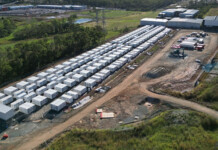
The bleeding obvious for simplest engineering is to make distribution networks independent by siting gas turbines, aeroderivative turbines, diesels to run conventional generation at terminal stations, and to site big batteries as near as possible (to absorb rooftop excess generation). That way all available roof space; factories, logistics, commercial buildings (plus batteries) would be exploited for energy independence. And where interconnection with another region would be essential, the existing transmission might be converted to direct-current operation.
You might wonder what your correspondent has been smoking. The above isn’t going to happen and as far as the Australian Energy Market Operator (AEMO) is concerned it is not even considered in its integrated systems plan. AEMO is anything but stupid—it employs very clever engineers and economists. Rest assured that they know all about technology options. However, the market operator is owned by stakeholders including electricity generators, and transmission and distribution companies.
The Integrated System Plan doesn’t break the mould of a traditional electricity system—large-scale generation via transmission to distribution to consumers. AEMO’s ISP is 100% based on this. And to give it credit, it does a fine job running the system—an increasingly complicated task to keep voltages and frequency stable throughout the south-eastern network.
But what could—and should—happen is that somebody without loyalty to transmission or generation be charged now—now, with no further delay—to take the present transmission and renewable energy zone layouts for review. For example, to break off the brilliant engineers at AEMO under Commonwealth Government edict and to place them along with selected academics in a think tank.
Related article: Renewables vs fossil fuels: Why can’t we walk and chew gum at the same time?
As to what to review:
- Max/min power capacities of existing transmission
- Max/min power capacities of transmission projects on foot
- Cancellation of planned transmission (until studies have been completed end reviewed)
- Consequent relocation or cancellation of renewable energy zones
- Exploitation of present terminal stations to avoid transmission lines expansion.
The above is an engineering study. When completed it can be sent to economists and bean counters and presented to the government as alternative to Rewiring the Nation and AEMO’s Integrated System Plan. We have enough brains in Australia to do this and we’re bound to benefit. The way we’re going at present will not benefit us—we paying for a ‘white elephant’ electrical energy system.
If you have read this far, you’ll recognise that any implementation is well—ahem—some sort of nationalisation. Heaven forfend! But remember, our electricity system piles profit margins on profit margins—everyone participating in the generation-transmission-distribution system gets to make a living. Any wonder that Mr and Mrs Kerfoops reach out for the government helping hand with batteries and solar.
Time to take stock is well and truly overdue.