Australia is accelerating a massive offshore wind industry to support its Net Zero 2050 targets, with the government identifying six priority zones for offshore wind development. While the nation is poised to capitalise on its offshore generation potential, the fledgling sector has encountered significant headwinds.
Australia’s offshore wind potential
According to the International Energy Agency, offshore wind is set to become one of the big three sources of renewable energy globally.
With some of the world’s strongest and most consistent winds at sea, Australia has the potential to become a world leader in the offshore wind sector.
Our vast oceans also allow the development of larger-scale projects boasting taller turbines that generate more electricity. In fact, just one offshore wind project can deliver the same capacity as 15 smaller onshore wind, solar and gas projects.
Offshore wind can also boost grid resilience. Meteorological data shows that offshore winds in New South Wales and the Bass Strait correlate with peak electricity demand periods, boosting energy security and keeping wholesale prices down.
With 87% of Australia’s population living within 50km of the coast, offshore wind farms can deliver clean electricity to population centres through existing infrastructure, requiring less investment in new transmission.
There are also great economic advantages to developing an offshore wind sector in Australia. According to a Clean Energy Council report, a scaled offshore wind industry of 20GW could boost Australia’s economy by up to $15.2 billion and create thousands of jobs in construction, operations, and maintenance, particularly in coastal towns and regions.
Related article: Winds of change
Priority zones and projects
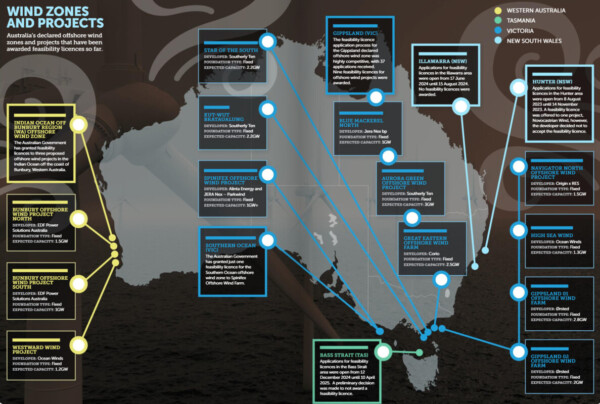
In December 2022, the Commonwealth Government formally declared the Bass Strait off Gippsland in Victoria as Australia’s first offshore wind zone. Since then, five other priority zones have been declared: the Southern Ocean in Victoria, the Hunter and Illawarra offshore wind zones in New South Wales, Indian Ocean off Bunbury in Western Australia, and Bass Strait in Tasmania.
Offshore wind developers were invited to submit project proposals for these declared zones, with the Commonwealth receiving approximately 65 proposals in total. Of these, 13 projects have been granted feasibility licences so far.
The types of activities that may be taken under a feasibility licence include: undertaking research and marine surveys to collect location-specific data; conducting detailed environmental assessments; preparing and publishing a supply chain and workforce analysis report that includes how the project will maximise its use of Australian suppliers, businesses, and workers; engaging with existing marine users, including commercial and recreational fishers; and consulting with the community and First Nations groups.

Trouble in the water
With the global offshore wind sector facing international investment headwinds, 2025 saw a number of proposed Australian offshore wind projects cancelled or put on ice.
In July 2025, BlueFloat Energy cancelled its 2.1GW Gippsland Dawn offshore wind project, which had been granted both a feasibility licence and Major Project Status by the Commonwealth Government.
A month later, Equinor decided to exit the proposed 2GW Novocastrian Offshore Wind Farm it was developing in the Hunter offshore wind zone with local partner Oceanex Energy. The project was offered a feasibility licence, however, the proponents declined to accept it.
In October, RWE announced its decision to cease development of its proposed Kent Offshore Wind Project off the Gippsland coast.
In December, AGL pulled the pin on its proposed 2.5GW Gippsland Skies offshore wind project in Victoria. The project was one of 11 projects granted a feasibility licence for the Gippsland region.
In September 2025, the Victorian Government announced it would postpone its Gippsland offshore wind tender, designed to allow developers to bid for government underwriting for their proposed projects, with winning tenders guaranteed a fixed price for electricity generated.
Victorian Minister for Energy and Resources Lily D’Ambrosio discussed the decision to delay the auction process, citing issues ranging from a lack of funding agreement from the federal government, delays to plans for the Port of Hastings renewables terminal, and global uncertainty in the offshore wind sector.
D’Ambrosio also said her government was “very conscious of changes in the international market and supply chains that need to be factored into our planning”.
The tender has now been scheduled for August this year for an initial 2GW of capacity.
“We’re working closely with developers on the progress of this exciting auction to ensure strong competition to secure the best projects and best value for Victorians,” the minister said.
Related article: Offshore wind investigations uncover maritime mystery
Major projects
Proposed offshore wind projects Star of the South and Blue Mackerel have secured Major Project Status with the Australian Government. Both projects are proposed for development in Victoria’s Gippsland offshore wind zone.
The granting of Major Project Status means a project will receive tailored support from the Major Projects Facilitation Agency, including assistance navigating regulatory approvals.
Australia’s most advanced offshore wind project, Star of the South, is an up to 2.2GW offshore wind energy project with the potential to power 1.2 million homes across its expected 30 years of operation.
Star of the South recently filed for approval under the Environment Protection and Biodiversity Conservation (EPBC) Act—the primary environmental approval required for the project to proceed. The environmental approval submission follows seven years of technical and environmental studies, including a world-class marine survey program. It draws on 26 technical studies examining potential effects of the project on environmental, cultural, social and economic values.
Star of the South CEO Charles Rattray said the assessment was the most comprehensive ever undertaken for an energy project in Australia.
“This environmental assessment reflects seven years of rigorous science and consultation to understand the local environment and how to protect it. We’ve done the work, and then some, to ensure government and the community can have confidence that the project will be delivered responsibly,” he said.
The project has been under development since 2017. It was granted an Exploration Licence in 2019 and a Feasibility Licence in 2024 to explore the potential for offshore wind in Bass Strait off the Gippsland coast. All initial feasibility studies have been completed, confirming that Star of the South is suitably located, technically feasible, and able to make a significant contribution to energy supply and emissions reduction.
If successful in securing all necessary approvals, construction on Star of the South will begin later this decade.
The Blue Mackerel offshore wind project being developed by JERA Nex BP has also been awarded Major Project Status by the federal government.
At full capacity, the 1GW offshore wind farm will supply enough electricity to power up to 750,000 Victorian homes a year by 2032.
To be located approximately 10km off the Gippsland coast, the Blue Mackerel offshore wind project is in its seven-year feasibility phase, with 2029 construction and 2032 operation targets.
The project has completed initial seabed surveys, secured major project status, and is conducting environmental assessments.
Below is a map of projects that have been approved by the Australian Government for feasibility licences so far.