By Phil Kreveld
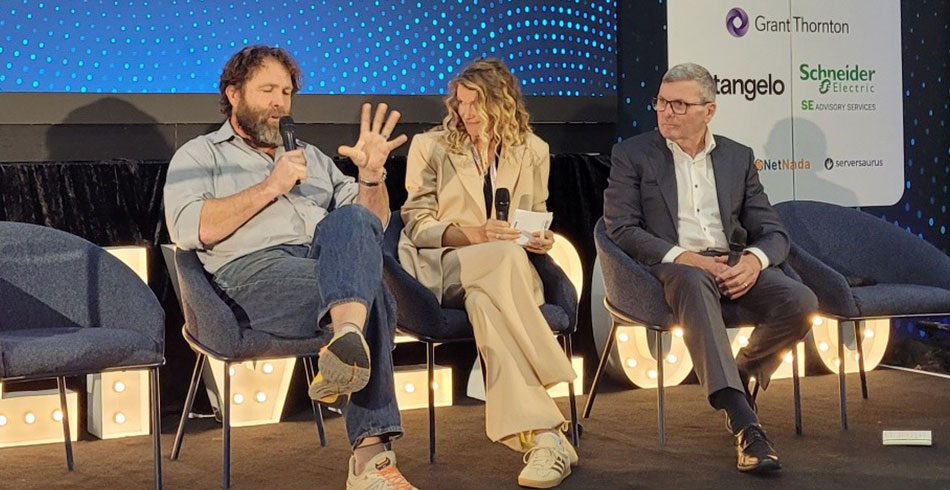
The much-publicised debate between Dr Saul Griffith of Rewiring Australia and Rewiring America and Sky News political journalist Chris Uhlmann took place at Sustainability Business Live on 3 June at the Melbourne Convention Centre.
The debate was moderated by Charlotte Connell, director for innovation and investment at Greenhouse, a climate tech hub for co-working in Sydney.
Related article: The Great Energy Debate: Uhlmann and Griffith go head-to-head on Australia’s energy future
Dr Saul Griffith in his opening statement made the case for renewable energy in giving Australia a fundamental competitive edge in energy-intensive industries such as steel and cement. A large landmass and low population density are prime ingredients, he argues—presumably because there is physical space for solar and wind generation, and therefore abundant capacity for industrial expansion. Dr Griffith also argued that the electrical energy market rules require adaptation to today’s technology, for example in permitting energy trading between prosumers—a democratisation of rooftop solar.
Chris Uhlmann stated that renewable energy carries with it the requirement for instantaneous balancing of generation and usage in perfect harmony, pointing out that the variability of generation makes for cost burdens, avoidable with conventional generation. Uhlmann pointed out that fossil fuels are in any event such a vital ingredient for our society, be it for fertilisers, plastics, and even toothpaste, that by implication their use for electrical power generation is almost a byproduct. Uhlmann’s position on fossil fuels is that in aggregate they have historically driven the increase in wealth of nations and for us as individuals. Dr Griffith countered this by stating that the ‘essential molecules’ needed for much of our daily needs, including fertilisers, can be abstracted without the need for fossil fuels, basically requiring energy as input for the appropriate chemical processes.
Griffith and Uhlmann agreed on the fact that since 1993, notwithstanding the high growth in renewable energy sources, CO2 emissions have risen. Dr Griffith denied Uhlmann’s claim that China, responsible for over 90% of the world’s production of solar panels, is powering the industry with conventional energy. Dr Griffith said that on a visit to solar cell manufacturing plants in Shenzhen, it was evident the energy requirements were met by renewables. In terms of Australia’s need for fossil fuel importation, Dr Griffith argued that electrification of conventional fuel using industries could result in savings of $130 million/day. However, the lack of financing credits for electrification is preventing the effective exploitation of Australia’s natural advantage, particularly for solar, but also wind energy.
Both speakers agreed that in spite of the capacity for self-generation, the grid is a reality that we cannot do without, and that we are stymied in achieving more economical electrical energy through a lack of necessary energy market reforms.
There was agreement that electricity costs have not abated in spite of the growth in renewables and that a thorough reform of markets is necessary. Dr Grifith again emphasised the need for energy trading between individual electricity consumers and Uhlmann made the case for nuclear generation as a means of reliable, zero emission technology. Dr Griffith agreed that nuclear generation was a realistic zero emission technology but of no advantage to Australia, given the national solar irradiation and wind resources.
In all, there were no sparks flying between the protagonists for opposite view points with Uhlmann cheerfully admitting that his household has solar and batteries. Refreshing to see that in spite of philosophical differences, in practical matters there is an agreed solution—solar works well at the household level.
I asked Dr Griffith, further to his remarks on the need for market reforms, whether the ‘ring fencing’ of distribution networks. i.e., in not being allowed to sell energy, should be lifted as this would alleviate the need for much transmission line expansion—and associated additional network costs. He responded that most network expenses that feed into electricity tariffs are those of distribution networks rather than those associated with transmission. He also stated that GPS-based inverter technology would allow much greater flexibility in distribution network operation—a subject deserving further exploration.
Related article: Renewables vs fossil fuels: Why can’t we walk and chew gum at the same time?
By way of observation, it is clear that the energy debate makes the case rather eloquently that Australia’s renewable transition is a journey assailed by complications that do not bear directly on the ‘physics of technologies’ but have much to do with politics, energy market regulations and the different aspirations of various jurisdictions.