By Phil Kreveld
Data centres can benefit distribution networks—even if they only connect to sub-transmission. Huh, did we hear that right? When they connect, their power demand can outstrip the ratings of substations and transformers. So far, not too impressive. But rather than focussing only on where data centre energy is coming from, we look at reintroducing synchronous machines in data centre substations—something that would really benefit distribution networks.
Some might conclude that bringing back synchronous generators is an atavistic move. Surely grid forming inverters that data centres are ‘encouraged’ to include in their substations are the same thing—and up-to-date technology. Fact is though, sometimes conveniently lost sight of, that when it comes to transient response, and in particular, fault current there’s nothing that comes close. That’s why synchronous condensers (basically the same thing as a synchronous generator but running as a no-load motor) are being installed in transmission networks. The big benefits a synchronous generator for a data centre brings, is voltage stability and lots of fault current for distribution networks. Fault current and voltage stability have been on a steady decline because of rooftop solar. The lack of fault current is the reason for protective gear operating unreliably!
Related article: Spotlight on the data centre debate
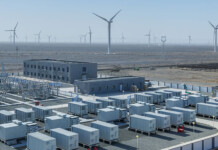
Why would data centres be interested in working for the ‘public good’? Short answer: they are not remotely interested in helping out distribution networks. Selfishly, they stand to benefit. Here’s why. Not only are they obliged to contract for renewable energy—not just existing generation, but new investment. Things are also made very difficult for them, stability-wise. Their power draw can vary hugely and very quickly, greatly affecting voltage stability. They are therefore required to provide stabilisation at their substations. The favoured technology is a battery energy storage system and grid forming inverter. The battery is there to absorb large dollops of power when the data centre suddenly reduces load. The grid former is there to simultaneously prop up voltage by providing dollops of reactive power.
Let’s look at the above arrangement. It’s not brilliant. Sure, the battery can provide power to the data centre—but, in order to keep its substation stable, the battery must maintain a low level of charge so as to be ready to absorb lots of energy when data centre demand suddenly reduces—and simultaneously stabilise voltage. That really means that the data centre in question would have two battery systems; one for network stabilisation, and second one for its ‘green energy’ demand. Of course, if they make that a really large battery system, they can have fun with energy arbitrage.
Guess what? The above options have been received rather coolly. This is now resulting in a charade in which gas is ‘on the nose’ but it’s OK for firming—a suitable loose term to make the ‘greenies’ a little more accommodating, and very importantly to give a data centre a reliable source of energy by way of a gas turbine and generator.
We don’t have to have gas—we can crank out synchronous power using ‘clean steam’. Renewable energy coming down the pike from renewable generators in the boondocks can be stored as sensible heat in graphite blocks at temperatures as high as 2000°C—for days and days, in fact, surpassing conventional battery storage capacities. A steam turbine getting its steam from a heat exchanger, drives the synchronous generator to power the data centre and with a sufficient name plate rating it can take care of distribution loads and other sub-transmission feeders.
Yes, conversion of heat to mechanical energy for the turbine is typically 40% but, we’re using cheaper and cheaper midday solar power. Rather than curtailment, data centres are saving renewables from standing by idly, spilling energy. However, just like the grid forming inverter, mentioned above, the generator can be disengaged from the turbine via a self-shifting clutch, thus running a synchronous condenser propping up voltage (inter alia, that would be in the event that for whatever reason the data centre was running off its own uninterruptible power supply).
Related article: Foretelling the future of the NEM grids
Not to be guilty of an excess of enthusiasm, it need be pointed out that switching from synchronous generation to synchronous condenser operation does not happen instantaneously. Think of a second or so, so that during this switch-over time, a smaller battery plus grid forming inverter would be needed. However, this doesn’t spoil the party. First, we get the advantage of synchronous generation as already mentioned (voltage stability and fault current), and secondly gas at teens of dollars per gigajoule is avoided.
Finally, the Australian Energy Market Operator’s Integrated System Plan forecasting 300GW of renewable capacity for just over twice today’s annual energy demand will actually be usable—note that data centres by 2050 are forecast to account for 14% of energy. The propeller heads at AEMO and elsewhere will breathe sighs of relief knowing that with more synchronous generation being inserted, here, there and everywhere, the nightmare of sub-synchronous oscillations will go from tens of Hertz to fractions. Let’s welcome data centres.