A new report has called out global banks behind Australia’s Barossa gas project, which is expected to release 13.5 million tons of CO2eq each year—approximately 3% of Australia’s annual carbon emissions.
Published by Solutions for Our Climate (SFOC), Environment Centre NT, Japan Center for Sustainable Environment and Society (JACSES), Jubilee Australia Research Centre, Reclaim Finance, and Urgewald, the report reveals nine banks that provided a total of US$1.15 billion in loans to build the Floating Production Storage and Offloading (FPSO) vessel, a ship that would process gas extracted from the Barossa gas field before transporting it to a nearby gas plant in Northern Australia.
Related article: Korean bank pauses on Santos loan for Barossa Gas Project
The banks financing the gas project include: Korea Development Bank (KDB), United Overseas Bank (UOB), Clifford Capital, MUFG Bank, Natixis, Oversea-Chinese Banking Corporation (OCBC), Sumitomo Mitsui Banking Corporation (SMBC), ABN Amro, and Cooperative Rabobank. In addition, Macquarie Bank served as a structuring bank, facilitating the entire financial transaction.
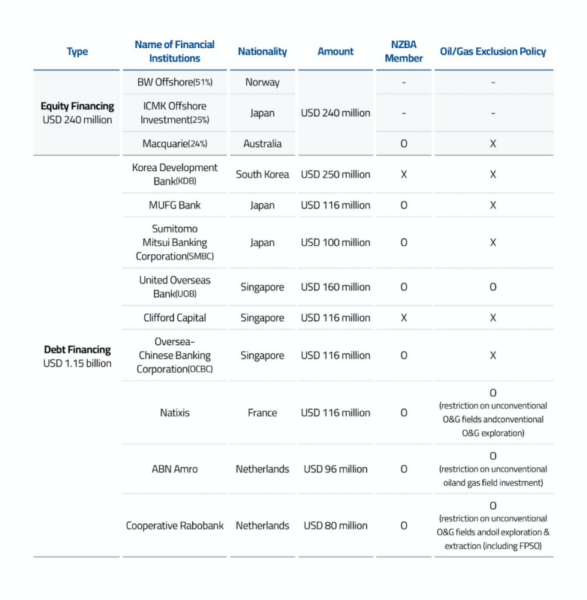
All of the banks involved, except for KDB and Clifford Capital, are committed to achieving net-zero by 2050 with their lending and investment portfolios, under the UN-convened Net-Zero Banking Alliance (NZBA). To meet this climate target, the world must stop developing new oil and gas fields, according to the International Energy Agency.
The report follows a series of legal challenges against the Santos-operated Barossa gas project led by Indigenous communities. Last December, the Australian Court revoked the project drilling permit for inadequate consultation of Traditional Owners. In March, Traditional Owners lodged a human rights complaint against banks associated with the project.
The organisations behind the report are urging financial institutions to withdraw their investments from the gas project. The banks are eligible for repayment from the project owners if major approvals and permits are not obtained, according to documents from KDB. The report also recommends that banks establish a policy to exclude financing for new oil and gas projects, including investments in FPSOs.
Related article: Santos faces new delay on Narrabri gas project
Reclaim Finance executive director Lucie Pinson said, “The involvement of these banks in this polluting project highlights the utter meaningless of the net zero pledges they have made. The signatories to the Net Zero Banking Alliance (NZBA), which include the French bank Natixis, want to be seen as climate leaders, but their actions show that they are still supporting the development of extremely damaging fossil fuel projects, which will lock us into a high carbon future. This is classic greenwashing and it is high time Natixis and the other NZBA banks stop financing new fossil gas projects, including Barossa.”
Urgewald director Heffa Schücking agreed, saying, “It is madness to finance new fossil fuel projects at a time when the UN and the world’s climate scientists are warning us that CO2 emissions must be halved by 2030. By backing the Barossa project, these banks are unleashing a new carbon bomb we can’t afford.”