By Phil Kreveld
SA Power Networks will today be conducting a ‘fire drill’ on the state’s grid in which it will switch off South Australian rooftop inverters.
This is the Emergency Backstop measure by which the Australian Energy Market Operator (AEMO) can switch off household and business solar inverters so as to maintain stability in the state and the eastern transmission network.
Emergency Backstop is sold as a rare event. But the ‘fire drill’ is likely to become a recurring event because the maintenance of stability will rest increasingly on AEMO intervention in energy markets. Its reliance on the five-minute despatch engine is wholly inadequate in the control of voltage and frequency stability, given the short time-frame variations in solar-generated power therefore mandating ‘within many seconds response’.
Related article: SA runs ‘fire drill for the grid’ in solar curtailment test
Hidden from public discussion is that the behaviour of renewables in the nation’s radial grids is no longer a train crash in slow motion—hence Emergency Backstop. ‘Emergency’ can probably be dropped as it likely to be routinely invoked. As recently reported in Hey Minister, wrong way—go back, distribution networks, and in particular SA Power Networks, distributing electrical energy to households and businesses, are increasingly energy independent. Deep duck curves are not only a problem (i.e., for the operation of markets) but so is instability caused by highly variable power flow.
South Australia’s synchronous stability hangs off a thread—that is the remains of a synchronous generator-based grid in the East. The state claims ‘renewable hero’ status, as it is often exporting solar and wind power. AEMO, however, is very anxious that islanding of South Australia not occur.
Islanding is an extreme measure, invoked because frequency stability, in particular, is threatened. It would be calamitous for South Australia because it has insufficient synchronous resources to maintain its own islanded network. Yes, it has synchronous condensers which are sold as the equivalent of synchronous generation—their task is mainly voltage control. Together with voltage forming inverters they can replace synchronous generation—but that is some time off.
The rationale for EnergyConnect linking New South Wales and South Australia is as much for energy transport as it is to help somewhat in providing voltage support. Its extraordinary length—one-seventh of a 50Hz wavelength, and therefore providing weak-synchronising torque—requires beefing up by means of thyristor-controlled shunt capacitors, and synchronous condensers. That is one of the reasons why its owner, Transgrid, went back to the Australian Energy Regulator (AER) for permission to add to its regulated asset base (and thus to add to network costs for the punters).
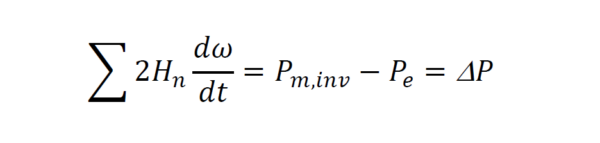
In the renewable energy transition journey, the engineering trials and tribulations are not considered by Australian governments. Or rather there is a convenient attitude, summed up by ‘markets will fix any technology shortcomings’. The living proof says otherwise. We are thus living an experiment with only AEMO as the responsible parent. The operator lives the following equation second by second:
Related article: Emergency backstop—a solar backflip?
It is an extreme simplification, a sort of mathematical summing up our national predicament. The ‘H’, an inertia-factor, summed up over all generation, be it synchronous or inverter based, is the guardian of frequency stability (dω/dt) being rate of change of frequency (RoCoF), and the Ps (with Pm, inv being power from synchronous and inverter sources, and Pe, the power demand) indicating power imbalance (∆P). Power imbalance is the daily risk requiring market intervention. Hence the fire drill—AEMO must be able to shut down the mums and dads of Australia.
So, how did it come to this?
In short, an ad hoc way of accommodating renewables, in particular in distribution networks. We had ample opportunity to do a national engineering plan. That is now gone and we are left with ‘fire drills’.