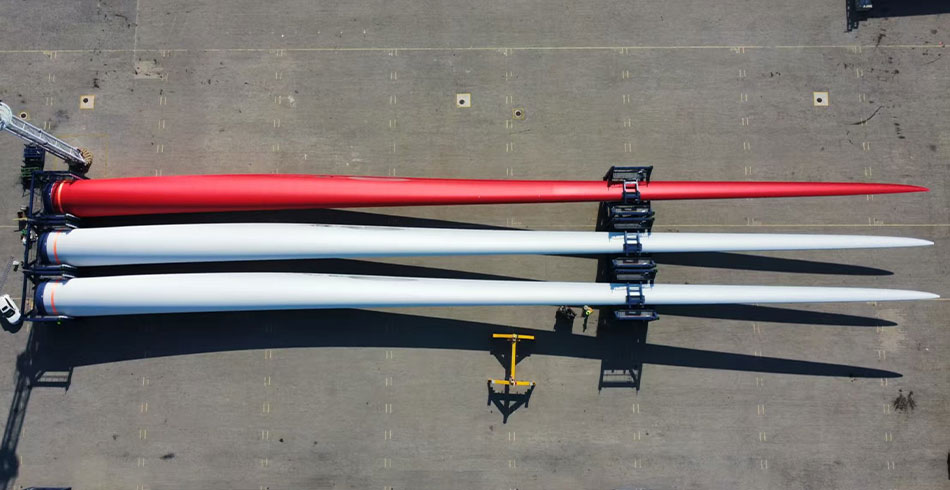
Ecowende and Vestas will utilise red turbine blades as part of a new trial at a wind farm in the Netherlands to investigate whether the colour will increase blade visibility to seabirds and help reduce the risk of collisions.
Multiple offshore wind farm studies in recent years have shown that collisions between seabirds and wind turbines are generally rare, as birds actively detect and avoid the rotor area. Nevertheless, continued research remains important to further reduce potential impacts and support responsible wind development at scale.
The distinctive red blade is part of a carefully designed field study led by Ecowende, in collaboration with Waardenburg Ecology, DHI, and Robin Radar Systems, with Vestas supporting production, delivery and installation.
Related article: ‘Not a single collision’: Studies say birds avoid wind turbines
Vestas vice president of sustainability Lisa Malmquist Ekstrand says, “This trial builds on the scientific understanding that seabirds largely avoid offshore wind turbines. By testing additional mitigation measures like blade visibility, we can strengthen the evidence base and help raise the bar for nature‑inclusive wind development.”
Following the evaluation of several colour options, red was selected based on performance criteria such as durability and heat management. The trial includes one red‑coated blade (115.5m) on each of seven V236-15.0 MW turbines, with several blade sets already en route to the Netherlands.
The objective of the single blade in a different colour is to create a smear, which is thought to be better visible for birds. A lot is still unknown on this effect, including which colours and patterns work best.
Initially, fluorescent colours as well as black were considered, but red was ultimately chosen based on performance criteria, particularly its ability to avoid overheating and ensure blade durability.
Ecowende and its research partners will evaluate whether this and other measures, including adaptive curtailment and creating a bird corridor, can effectively safeguard birdlife. These efforts are part of an overall ecological concept that goes beyond current industry standards.
Related article: Solar farms look like lakes to birds—and it’s skewing their migrations
Vestas technical project manager Hollandse Kust West VI says, “Many countries now emphasize ecological considerations in project permitting. While this specific initiative is still being tested and evaluated, it’s a valuable opportunity for us to explore what’s possible and prepare for evolving regulatory and environmental expectations.”
Ecowende wind turbine engineer Thomas Haex adds, “By testing a wide variety of promising innovations, Ecowende aims to prove the most effective technologies. We share this knowledge to support future offshore wind projects, helping to minimise the impact on birdlife while maximising renewable energy production—driving the energy transition in harmony with nature.”