By Phil Kreveld
Earlier this year, the Australian Energy Market Operator (AEMO) assured punters that only in the case of grid instability would distribution networks be instructed to switch off rooftop solar systems.
For that eventuality, post-October 2024, new inverters would have to be capable of remote switch-off. This would assure sufficient power flow in high voltage transmission lines—i.e., ‘prevent grid instability’. Below is AEMO’s October statement on the necessity for the measure—or is it?
Related article: ‘Dunkelflaute’ and weak grids
“AEMO is publishing a Statement of Need under clause 3.11.12(a) of the National Electricity Rules to acquire Type 2 Transitional Services for the purpose of managing Minimum System Load conditions.
“Australians continue to invest in Distributed Photovoltaics (DPV), batteries and other consumer energy resources at world-leading levels. More than one third of homes across the country now host rooftop solar systems, helping households and businesses reduce their energy bills and directly contributing to the decarbonisation of the energy system. A concerted effort is required to ensure these consumer energy resources are effectively integrated into the power system as uptake increases, in a way that supports the secure and reliable delivery of electricity to all consumers now and into the future.
“At present, the power system relies on large-scale plant to deliver a range of essential system security services, including fault current, voltage waveform stability, inertia, and voltage and frequency management. To provide these services, large-scale plant must operate above their minimum safe operating levels. With increasing daytime generation from DPV, operational demand on the transmission network is falling. During these periods, it may not be possible to dispatch enough large-scale plant above their minimum safe operating levels to deliver these essential security services.”
As to the open question above—well, what is the concern? Is it to assure that the ‘big end of town’ makes a quid? No, not really. AEMO knows that voltage control in high voltage transmission lines carrying very little, or worse, zero power, would be a massive headache, and its cure massively expensive. The operator’s worry that large-scale plant operate above “above their minimum safe operating levels” is disingenuous. Were the grid entirely serviced by synchronous generators connected to steam turbines, well, yes, that would be a credible concern. Their power cannot be spilled unlike wind and solar; at best a coal-plant could be operated on a two-shift basis, keeping everything warm and under steam until night time when there’s no solar. Gas turbines do not have this problem. The fault current argument carries some weight. However, differential and impedance relaying, though complicated, can overcome the negative feature associated with inverters replacing synchronous sources.
‘Emergency backstop’ seems an ill-chosen term for constraining the power output from rooftop solar photovoltaic systems. What ‘emergency’ could be contemplated? The Clean Energy Council appears to be okay with it—a shutting down of power export from solar inverters in case of an ‘emergency’ which is whatever AEMO proclaims it to be—as in Alice in Wonderland. As already mentioned above it is voltage control in high-voltage transmission lines. It isn’t an emergency—it is the result of unrestrained growth in rooftop solar.
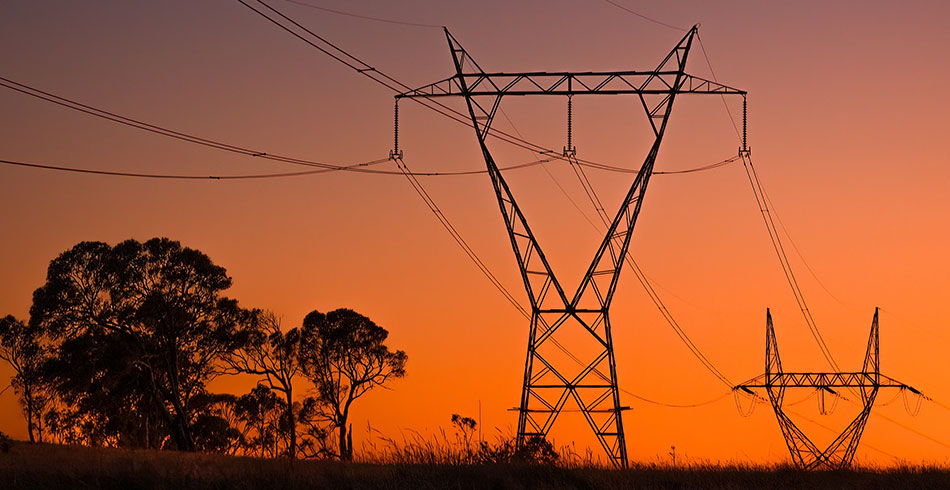
How low can power flow go? It’s not limbo rock. At a certain low power flow, a long transmission line begins to ‘charge up’ (electric current charges up the transmission line capacitance between the phases, and phases and earth, and consequently voltage rises (this is was a contributing factor in Spain’s grid collapse on April 28, 2025).
The punters are ‘assured’ that emergency backstop will happen rarely. But which is it—reducing power export or switch off? In essence, if AEMO has difficulty in maintaining voltage stability in the transmission grid, it will order distribution networks to remotely control (reduce) power export from rooftop solar PV, or demand a switch-off.
If the transmission line system has to operate for a wide range of power flows as well as zero power (there actually in no such thing, that is to say, no active power but large reactive power flow), the latter component would require absorption by under-excited synchronous condensers, whereas normally these would operate in over-excited mode.
Related article: Problem creators and solvers
This complicates the control of excitation current for loaded and unloaded scenarios which could follow each other in quick succession, and AEMO probably sees no practical, economic ways of achieving this. And in event, it’s the transmission owners who would have to do the investing, going cap in hand to the Australian Energy Regulator, for permission to raise transmission charges (seems odd reasoning since active power being transmitted is not increasing—in fact, decreasing as a result of the growth in consumer energy resources).
In conclusion, there is a clash of technologies—large scale versus small scale. It is perfectly clear that AEMO is refereeing in favour of large scale. As to how low it will allow transmission power flow to go—that remains the question!