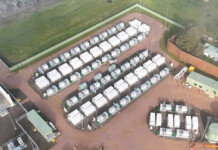
What began as a research project to develop a thermionic converter has resulted in game-changing technology designed to decarbonise the industrial heating sector, which accounts for 42% of Australia’s end-use energy.
After more than a decade of development, MGA Thermal’s world-first commercial Electro-Thermal Energy Storage (ETES) system—capable of dispatching industrial-grade steam from renewable energy—has gone live.
This groundbreaking technology significantly outperforms conventional sensible heat thermal storage, offering a viable pathway to 24/7 renewable heat for industries—effectively replacing reliance on carbon-intensive fossil fuels.
MGA Thermal’s newly commissioned demonstration plant is fully operational, producing superheated steam outputs while the storage material undergoes a material phase change to release latent heat. Steam—the workhorse of industrial manufacturing for centuries—accounts for nearly half of Australia’s 47% energy consumption in heavy industries alone and is at present primarily generated from the burning of fossil fuels.
Related article: MGA Thermal achieves world-first renewable industrial steam

MGA Thermal’s demonstration plant shatters this paradigm by converting intermittent renewable electricity into reliably stored thermal energy, with the potential to scale to GWh storage capacities.
Located at MGA Thermal’s Tomago site, the demonstration unit stores 5MWh of energy with a 500kW thermal dispatch power, providing continuous superheated steam for a full 24 hours—enough energy to power over 270 homes for the same duration.
Erich Kisi is co-founder and chief scientist at MGA Thermal, and co-inventor of the patented Miscibility Gap Alloy (MGA) thermal energy storage materials the company was named after.
“A colleague and I had a grant to develop a thermionic converter using concentrated sunlight as a heat source to generate direct electricity. My colleague started thinking about what happens at nighttime or during long periods of cloudy conditions. So, we pivoted our activities towards finding ways to store the heat we generated. It didn’t actually take us long to come up with the concept of MGA materials for use as thermal blocks, which the University of Newcastle then patented,” Kisi explains.
Kisi and his colleagues attempted commercialisation from within the university but quickly realised it was going to be a difficult road.
“We were relying on the university’s tech transfer office to do all the heavy lifting while we focused on our lab work,” he recalls.
“Eventually, we realised commercialisation isn’t a spectator sport. You have to either be doing it or it’s not happening.”
Kisi’s former PhD student, Dr Alex Post, was working on a slightly different topic but had strong connections at CSIRO. Together, they enrolled in the CSIRO-run commercialisation course called ON Accelerate.
“During that we founded the company, secured our first customer and things took off from there. A few months later, we signed the co-development agreement with that first customer and an IP licence agreement with the university,” Kisi explains.
“Through the CSIRO program, we were encouraged to think about what we could do quickly at a modest scale. What’s the minimum viable product going to be? We moved from concentrated solar power to thinking about retrofitting power stations with thermal storage to replace the boiler. There’s a lot of power stations with some life left in the turbines, and so to help them decarbonise seemed like a great opportunity. Over time, we have moved into the industrial heating sector.”

MGA Thermal’s utilisation of latent heat means that energy is stored more compactly, both in physical plant footprint and storage temperature range. This serves to make latent heat ETES more space efficient, reliable, energy efficient, and affordable than sensible heat storage.
Importantly, each ETES system is scaled to suit the customer’s site and electric charging, storage and heat requirements. A major advantage is the charge system’s ability to be worked on or maintained while being fully operational— eliminating the need for downtime.
While the technology is proven, Kisi acknowledges the inherent challenges that come with introducing an innovation to established industries.
“Our focus is showcasing the capabilities of our technology and building trust with industries that have relied on the same systems for decades,” he says.
“It’s a big shift for customers, but we’re already seeing a lot of momentum.”
Rather than building a pilot plant at a customer’s site, ARENA sponsored MGA Thermal in developing its own demonstration unit, giving potential customers the opportunity to see it in person and kick the tyres, so to speak.
“It takes a lot of people by surprise when they see it in person,” Kisi says.
“We’ve had representatives from Fortune 50 companies comment, ‘Erich, this is not a demonstrator—this is an actual industrial unit.’ They come thinking it’s going to be a small-scale prototype and discover it’s a 5MW commercial-scale production system in a 5,500m2 factory, which also houses the MGA R&D lab.
“Up close, they can see firsthand that when generating steam, the unit is actually only 60 degrees on the outside while being over 600 degrees on the inside. It doesn’t make any sound, either—it’s incredibly quiet. If you go and stand next to it you can hear the fan, or perhaps the gentle hiss of steam from the valve, but otherwise, silence.”
MGA Thermal is in a growth phase to increase its production capacity so it can deploy larger and larger ETES in factories.

Related article: Chevron selects MGA Thermal for clean steam study
“They can range in size from small 5MWh units right up to the largest size we’ve scoped, which is 6GWh. Our production capacity will grow steadily to match those larger units,” Kisi says.
With plans to develop a gigawatt-scale production line, the company’s feelers are out for investors. CEO Mark Croudace says, “Our now-operational demonstration plant isn’t just a concept—it’s a commercially viable solution ready for deployment.
“As we engage in full-scale commercialisation, our focus is on partnering with forward-thinking industries, both locally and globally, eager to embrace a sustainable future. The potential for significant emissions reduction is immense, and we are on track to abate 30 million tonnes of CO2 by 2030.
“This is the missing piece of the puzzle for heavy industry decarbonisation.”