Australia’s national science agency, CSIRO, and the Australian Energy Market Operator (AEMO) have released the draft GenCost 2025-26 Report for public consultation.
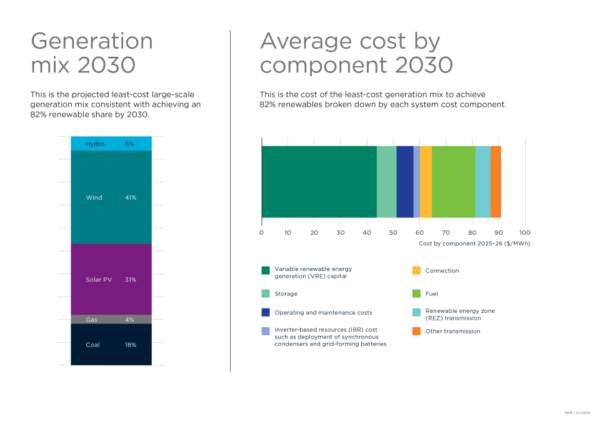
The report provides the cost of new-build electricity generation in terms of capital costs and comparative costs of delivered electricity from individual technologies. It also introduces a new method that examines the electricity generation mix and the average cost of electricity for achieving Australia’s 82% renewable energy target by 2030 and reaching net zero emissions by 2050 under different electricity emission intensity scenarios.
Related article: AEMO releases draft 2026 Integrated System Plan
In both cases, the draft report shows solar PV and onshore wind form the basis for the least-cost generation mix.
Key findings from the draft report include:
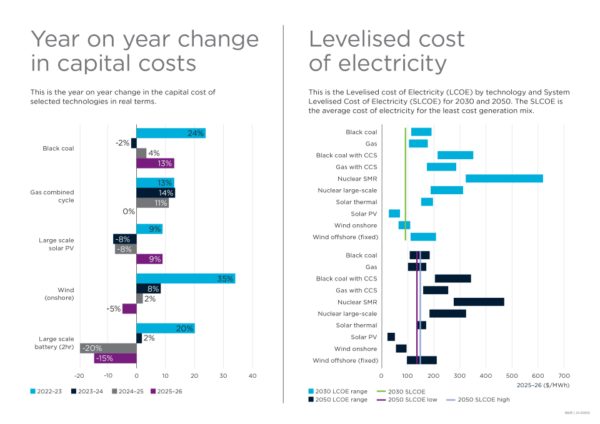
- Capital cost trends: Battery technologies continue to show significant double digit cost reductions; large-scale solar has a first cost rise in three years; onshore wind costs show tentative signs of stabilising; while nuclear, coal and gas open cycle cost trends increase due to higher steam and gas turbine technology costs.
- 2030 generation costs: To meet Australia’s target of 82% renewable energy by 2030, the electricity cost is estimated to be about $91 per megawatt-hour (MWh) when transmission is included, or $81/MWh for generation alone.
- 2050 generation costs: To deliver net zero by 2050, generation costs were projected to be $135–$148/MWh including transmission, or $114-$124/MWh for wholesale generation costs only. This is slightly lower than the National Energy Market (NEM) volume-weighted generation prices of around $129/MWh in 2024-25.
- Electricity sector emissions: To deliver net zero by 2050, the efficient electricity sector emissions intensity is estimated at 0.02–0.05 tCO₂e/MWh, compared to the current level of about 0.5tCO2e/MWh. The report found eliminating all electricity sector emissions would be more costly than reducing emissions elsewhere in the economy. However, if electricity emissions intensity was higher than 0.05 tCO₂e/MWh, it would make achieving net zero more expensive overall.
CSIRO and AEMO have collaborated on the annual GenCost report since 2018, delivering a policy-neutral and technology-agnostic assessment that provides industry decision makers with cost data for a range of new-build electricity generation and storage technologies to support electricity system modelling and planning for Australia.
The report is underpinned by a transparent and collaborative approach that considers stakeholder input and improves GenCost’s data and methodologies each year. Stakeholders are invited to review the consultation draft and provide feedback. For details on how to participate, visit the AEMO consultation website.
CSIRO chief energy economist and GenCost project leader Paul Graham said, “GenCost has evolved from delivering verifiable cost data on individual technologies to now also providing system modelling of the future generation mix and average cost of wholesale electricity.
Related article: GenCost shows renewables still lowest cost new-build energy
“Electricity systems will always require a diversity of resources to deliver all their functions and so no single technology will meet all the system’s needs regardless of its relative cost position.”
AEMO executive general manager system design Nicola Falcon said, “CSIRO’s process to regularly monitor, consult on and update generation technology cost trajectories is incredibly valuable in planning for a reliable and least-cost electricity market.”