Highly skilled helicopter and drone pilots are spearheading a precise aerial operation to string thousands of kilometres of cabling across hundreds of steel towers as construction of the nation-critical HumeLink transmission project progresses.
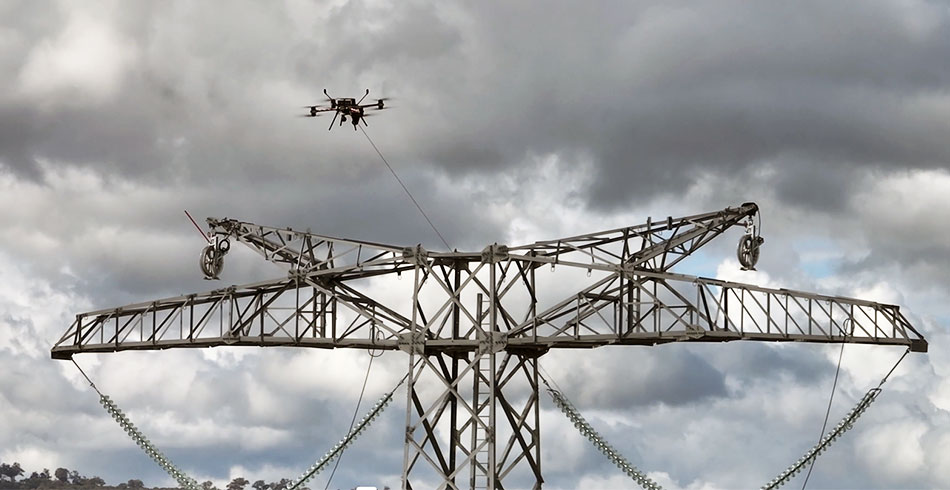
Using helicopters and Australian-invented drone technology, aerial stringing is underway to install more than 9,000km of high-voltage conductor across more than 820 towers between Wagga Wagga and Maragle in the Riverina and Bannaby in the Southern Tablelands.
Transgrid HumeLink program director John Burke said the aerial methods were delivering the work safely and with less impact on communities along the alignment.
Related article: Rise of the robots in the race to renewables
“We are getting on with the job of delivering this nation-building project, which is critical to delivering lower-cost and cleaner energy to millions of consumers before coal-fired power stations retire,” Burke said.
“Using pinpoint accuracy and precision manoeuvring, Leading Edge Helicopters and Infravision drones are providing safe, fast and low-impact installation of high-voltage transmission lines.
“This approach reduces impacts on local roads, properties and their owners, compared to traditional stringing, which uses heavy machinery to drag conductors between towers.”
Highly-skilled pilots carefully guide draw wires into the centre of pulley blocks attached to each tower and use them to pull the permanent conductor into place.
Leading Edge Helicopters pilot John Caldwell is drawing on decades of flying experience during the operation on the HumeLink East alignment, working in constant communication with ground crews.
“The work demands accuracy measured in millimetres,” Caldwell said.
“You just have to guide the wire. It becomes an extension of you really.
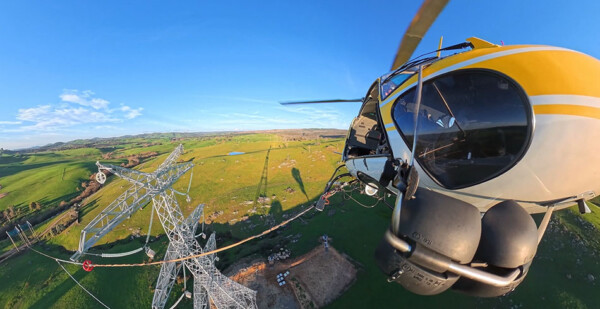
“It does take a bit of skill but it’s five times faster using the helicopter compared to traditional methods. It’s much more efficient and environmentally friendly doing this work by helicopter and drone.”
Infravision developed and commercialised its drone-based stringing system in Australia, working closely with Transgrid and other Australian utilities, and is now deploying the technology across the United States and Canada.
The system allows construction to keep moving during adverse weather conditions, with the drones able to operate in winds exceeding 50km/h and in temperatures from below 0 to above 50 degrees Celsius.
Infravision is installing the complete draw-wire package across the 140km HumeLink West section using four of its drone systems, with work currently underway on the newly built transmission towers at Book Book, south-east of Wagga Wagga.
Infravision chief remote pilot Philip Phoebe said the technology had significantly changed the nature of the work.
“Flying these systems takes constant situational awareness and precise coordination with the ground crews, who operate using onboard cameras and telemetry,” he said.
“Our system allows more of the work to happen above the corridor rather than through it.”
Related article: Giant shunt reactors arrive for HumeLink transmission project
HumeLink comprises construction of 365km of new 500kV transmission lines and new or upgraded substation infrastructure at four locations by delivery partners ACCIONA and GenusPlus Group Joint Venture for HumeLink East and UGL and CPB Contractors Joint Venture for HumeLink West.
Construction of the project is on track to be completed in late 2027.