An Australian research team has surpassed the 30% solar cell efficiency target with a potentially low cost breakthrough technology, according to ARENA.
In an era of rapid climate change, three factors have dominated the race to deliver solar electricity: solar cell efficiency; combined manufacturing, deployment and operational costs; and a very short timeframe.
Related article: Pioneering rooftop solar trial to benefit customers
ARENA has set ambitious targets for each of these. Launched in September 2021 and dubbed Solar 30 30 30, ARENA’s goal is to lift solar cell efficiency to 30% and reduce the cost of solar modules in the field to 30 cents a watt. The final 30 represents the target date of 2030, a mere seven years from now.
Could a class of materials first discovered in Russia’s Ural Mountains in the mid 19th century be the key to reaching those targets?
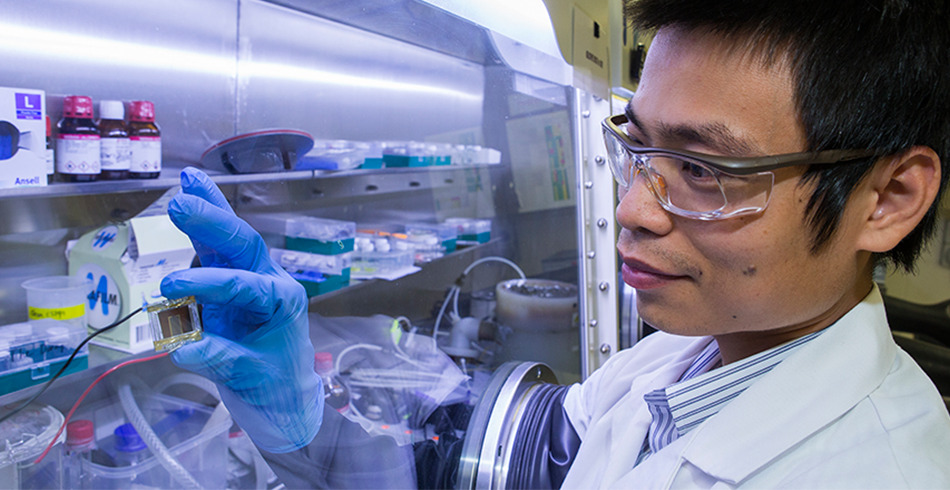
Now, a team of researchers at the ANU led by Dr The Duong has produced in the lab a solar cell with an efficiency of 30.3%, using perovskite.
Perovskites, named after Russian minerologist Lev Perovski, are known to have potentially high solar cell efficiency but are notoriously unstable. Dr Duong’s team has demonstrated a method of stabilising the structure of a perovskite
The ANU team’s work has been financially supported by ARENA through the Australian Centre for Advanced Photovoltaics (ACAP). ARENA in June 2022 announced up to $45 million funding to ACAP to extend operations of their cutting-edge solar photovoltaic (PV) research to 2030. And in January 2023, ARENA announced a total of $41.5 million funding to 13 projects focused on delivering Ultra Low Cost Solar.
”We have discovered a simple method to significantly improve the quality of the perovskite material and therefore we can improve both the efficiency and the stability of the perovskite in the cell,” Dr Duong said.
Related article: Aussie solar pioneers win world’s top engineering prize
“When combing these perovskite solar cells with silicon cells in a 4-terminal tandem configuration, we achieved 30.3% efficiency. That means 30.3% of the energy of the sunlight had been converted into electricity.
“Our work not only demonstrated perovskite-silicon tandem solar cells with ultra-high efficiency, but we also show that the devices have excellent stability.”
Read the full article here.