In its 2026 Integrated System Plan, the Australian Energy Market Operator (AEMO) says Australia’s least-cost path forward is renewable energy, supported by storage, connected by transmission and distribution, and backed up by gas.
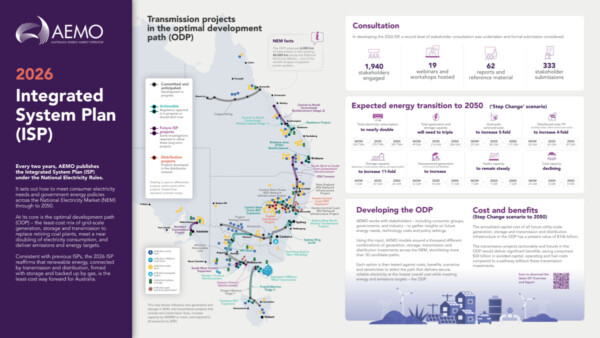
The centrepiece of the ISP is the optimal development path (ODP), which sets out the least-cost way to support secure and reliable electricity supply as coal power stations retire and electricity consumption near doubles, while meeting government policy through to 2050.
Key changes since the 2024 ISP include lower solar and battery costs, higher costs for transmission and wind projects, and stronger growth in consumer energy resources.
Related article: AEMO releases draft 2026 Integrated System Plan
AEMO CEO Daniel Westerman said, “Over the forecast period, Australia’s ageing coal-fired power stations will close while electricity consumption is forecast to nearly double. At the same time, consumers are continuing to invest in rooftop solar and home batteries, which benefits all consumers by reducing the need for grid-scale investment.”
AEMO tested around 1,000 different combinations of generation, storage, network and consumer investments across three future scenarios, supported by detailed cost-benefit analysis.
Under the Step Change scenario, the plan involves around $106 billion in annualised capital investment to 2050 (in today’s dollars). Around $6 billion of this is for transmission, which would deliver significant benefits, saving consumers $30 billion in avoided capital, operating and fuel costs compared to a pathway without these transmission investments.
“Transmission is a relatively small share of overall system investment but delivers substantial benefits for consumers by unlocking lower-cost energy across the National Electricity Market,” Westerman said.
“The direction for Australia’s energy future remains clear it’s renewable energy, supported by storage, connected by transmission and distribution, and backed up by gas,” he said.
The ISP tests the robustness of the ODP under a range of sensitivities, including varying levels of consumer energy coordination and energy efficiency, higher demand from industrial loads such as data centres, and constrained delivery of generation and transmission.
AEMO’s constrained delivery sensitivity shows that if generation, storage and transmission projects are delayed and more costly in the near term, the actionable transmission projects identified in the ODP continue to deliver significant benefits to consumers. Without them, system costs rise and reliability risks increase.
Related article: In defense of AEMO and its sorrows
“Delivering these transmission projects without delay is critical, as the need and consumer benefits are clear,” Westerman said.
“Australia’s energy transition requires a whole-of-system approach, one that maximises value from generation, storage and transmission with the growing contribution of homes and businesses through rooftop solar, batteries and more flexible energy use,” he said.