Renewable energy supported by storage is helping to protect Australia from the full force of global energy turmoil and continues to provide the lowest cost pathway for Australia’s electricity system to achieve net zero emissions.
These findings are at the centre of the GenCost 2025-26 Final Report, which is produced by Australia’s national science agency, CSIRO, in partnership with the Australian Energy Market Operator (AEMO).
Now in its eighth year, GenCost provides Australia’s most comprehensive annual assessment of the costs of new-build electricity generation, storage and hydrogen technologies.
Related article: Polling shows Aussies back industry fuelled by renewables
Key findings from the report include:
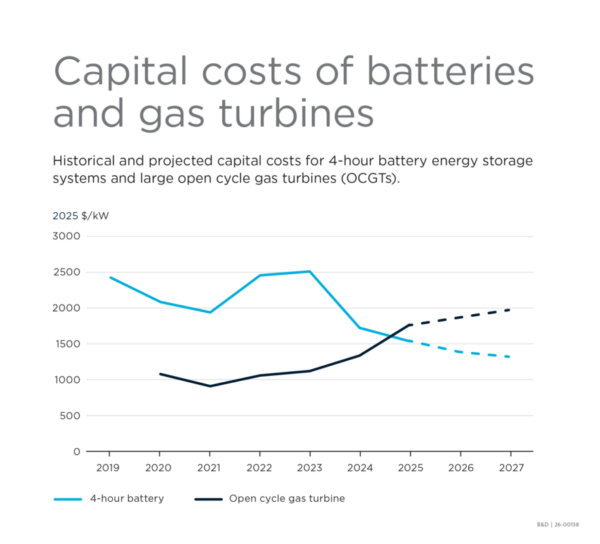
- Battery technologies continue to deliver cost reductions while rising demand for gas turbines to power US data centres is increasing costs for gas-based technologies.
- Growing capacity of lower cost batteries capacity is beginning to reshape electricity markets, competing with traditional gas peaking generation and contributing to lower evening peak prices.
- Renewables supported by storage remain the lowest-cost generation investments for Australia’s future electricity system to achieve net zero, with solar PV and onshore wind projected to supply 93% of electricity by 2050.
- By 2050, all new electricity generation technologies are projected to cost more than $100/MWh as ageing assets are replaced across the system.
The average National Electricity Market (NEM) generation price reached approximately $104/MWh in 2025, down from a peak of $189/MWh in 2022, driven by high global gas prices. Market expectations based on electricity futures prices indicate generation costs could fall further to between $80 and $90/MWh by 2030.
CSIRO chief energy economist and GenCost project leader Paul Graham said understanding how global events and technology markets influence electricity generation capital costs is a key part of GenCost’s role.
“As battery costs continue to fall and gas technology costs rise, batteries are increasingly becoming the preferred flexible generation technology in the near term,” Graham said.
“However, GenCost modelling finds gas technologies will still play a limited but important role in helping firm the electricity system, contributing around 3-7% of generation by 2050.”
The report also finds that while some non-renewable technologies, such as new black coal, are potentially cost-competitive with renewables, their use would require higher cost carbon abatement elsewhere in the economy to achieve Australia’s net-zero goals.
Growing global demand for gas turbines is emerging as a key driver of higher costs for gas-based generation. According to the International Energy Agency, US data centres are now among the world’s largest sources of gas turbine demand, contributing to sustained cost increases that are expected to continue.
Related article: Australia’s renewables rollout must hit “warp speed”
Solar PV and onshore wind remain the backbone of a least-cost future electricity system. Under a net zero scenario, these technologies are projected to supply 93% of Australia’s electricity by 2050, supported by hydro, storage, transmission and flexible generation such as gas and hydrogen.
Looking further ahead, no new electricity generation technology is expected to deliver electricity below $100/MWh. As today’s generation fleet retires, future electricity costs will increasingly reflect the cost of building replacement infrastructure.