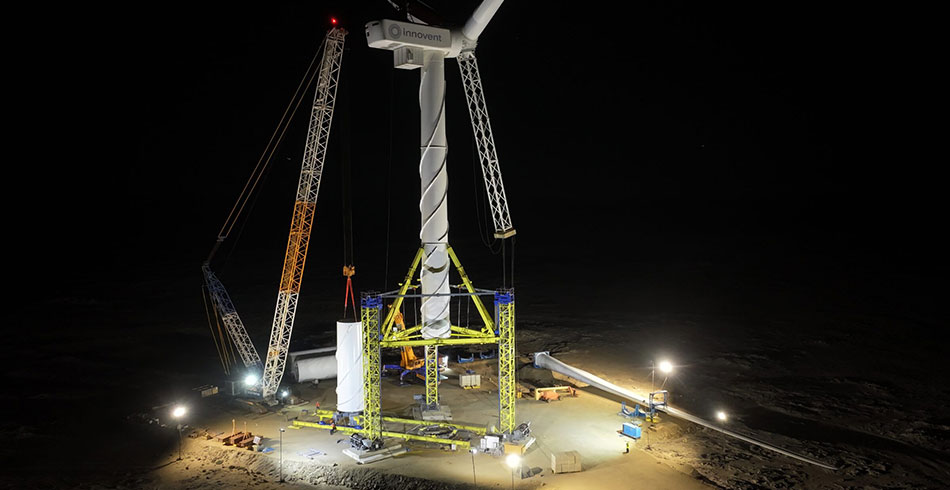
Fortescue wind technology company Nabrawind has successfully completed installation of the first Goldwind GW165/6000 wind turbine at the InnoVent Diaz wind farm in Namibia despite extreme wind conditions.
Nabrawind says this milestone not only validates this technology for the wind energy sector but also sets a precedent for the installation of large-scale turbines in locations with extreme wind conditions where large cranes are not available.
The Skylift lifting system integrates two technologies developed by Nabrawind: the Self-Erecting System (Total SES), adapted to conventional tubular towers, and BladeRunner. Both technologies eliminate the need for large-tonnage cranes, overcoming the main logistical challenge in wind farms where crane access is difficult and wind conditions are extreme.
Related article: Envision connects first AI wind turbine for Fortescue
The technology developed by Nabralift has evolved, making it possible to lift any type of tower once the rotor has been installed at a height of 30–40m. The operation is performed reliably in unstable winds, at speeds of 15m/s and bursts of up to 20m/s, unlike conventional cranes that can only operate in winds of up to 6–8m/s for the installation of certain components, such as the blades.
In addition, the system allows for the hoisting of sections of thin-walled tubular towers without compromising their structural integrity, thanks to Total SES technology, which builds on Nabralift’s Self-Erecting System (SES) to enable its use on all types of wind towers.
Goldwind’s GW165/6000 wind turbine is a direct-drive model, which has led Nabrawind’s engineering team to develop another pioneering system—one that is essential for wind turbines of this type.
After hoisting the first section and the nacelle, two blades were installed at a 30-degree angle to the ground, using a proprietary handling system and a counterweight that stabilises the rotor until it reaches the final hub height.
Finally, this counterweight is replaced by the third blade thanks to the BladeRunner system. This is the first time this solution has been used with the two blades in a 30 degree position, which represents the highest degree of difficulty for the project.
The InnoVent Diaz wind farm will feature seven Goldwind GW165/6000 wind turbines. This allows Nabrawind to demonstrate both its ability to handle complex installation procedures and the system’s operational reliability under standard conditions, to complete the installation of the seventh turbine in a net cycle time of one week.
Nabrawind’s self-erecting tower technology is also being deployed at Fortescue’s Nullagine Wind Project in Western Australia’s Pilbara.
Related article: Vestas trials red turbine blades to mitigate bird collisions
The project features 17 Envision EN182-7.8MW AI wind turbines, specifically designed for Australia’s mining and desert environments, local wind conditions, and stringent grid requirements.
The turbine integrates Nabrawind’s self-erecting tower technology with a hub height of 188m, setting a global benchmark for onshore wind and unlocking higher energy yield.