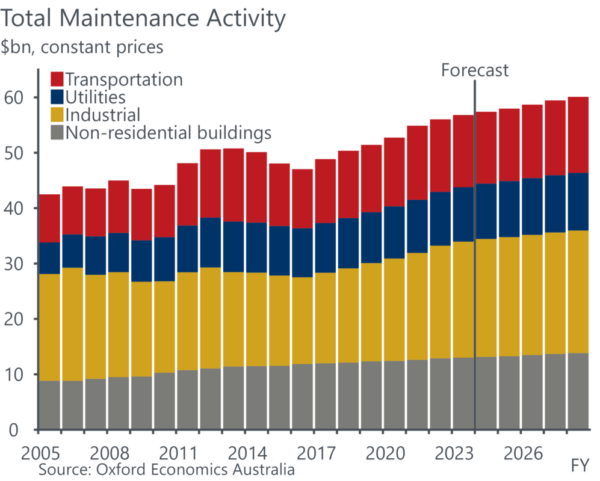
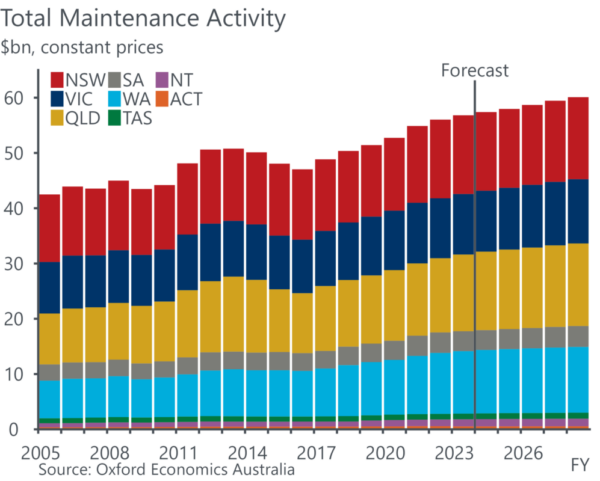
Oxford Economics Australia has released findings from its Maintenance in Australia report, which estimates and forecasts maintenance spending across the transportation, utilities, mining, manufacturing and non-residential building sectors.
According to the research, renewable energy transition is slowing growth in electricity maintenance spending—and there will be some years where maintenance on electricity generators falls.
Related article: Interim authorisation for coordinated NEM maintenance
Oxford Economics Australia head of global construction forecasting Dr Nicholas Fearnley said, “Renewable generators require much less maintenance than fossil fuel generators per megawatt hour, and so maintenance spending will naturally fall as coal power plants are replaced by wind and solar solutions.
“This isn’t necessarily bad news for maintenance providers, as those who are positioned to provide maintenance to renewable generators will continue to face a growing market.”
This reduced spending, however, will be largely offset by growing maintenance spending on transmission networks as they are expanded to unlock new renewable energy zones, and some regulators have increased the allowed CAPEX for electricity distribution and transmission companies.
Related article: Government announces Australia’s largest renewables tender
“We think these decisions will be repeated by other state regulators in upcoming pricing reviews and so signals higher maintenance spending for network owners,” Dr Fearnley said.
Electricity generation maintenance spending is expected to fall from $978 million in FY23 to $964 million in FY24, reaching a low of $644 million in FY33.