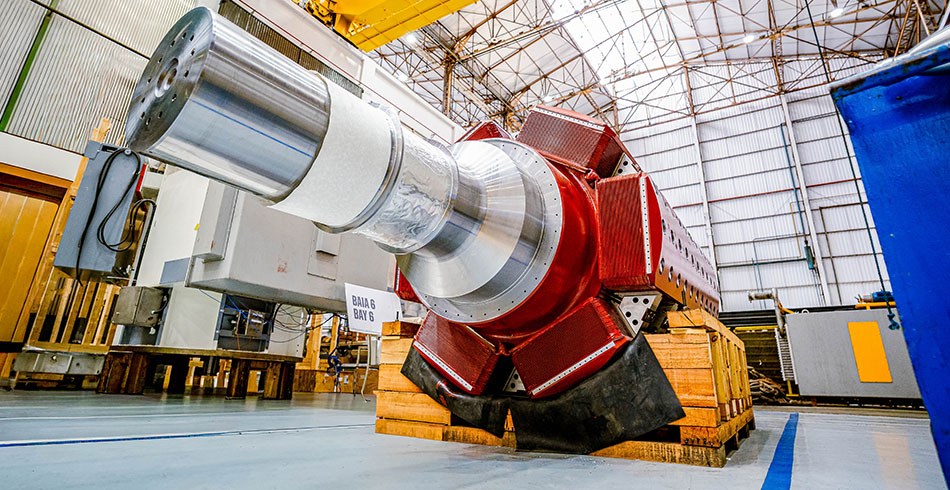
Transgrid has begun readying New South Wales’ transmission system to enable the installation of 10 synchronous condensers—or ‘syncons’ as they are known colloquially—massive spinning machines that will help stabilise the grid as it transitions from coal to renewables.
The syncons will be deployed across five sites under the first phase of Transgrid’s System Strength Plan, following a NSW Government direction to accelerate procurement of this equipment as a Priority Network Infrastructure Project (PNIP).
Transgrid executive general manager of network Jason Krstanoski said construction partners had been engaged to carry out project-enabling works, which have already started at the first two priority sites in Newcastle and Kemps Creek.
Related article: More batteries, fewer syncons in NSW system strength plan
“We are pleased to announce that Consolidated Power Projects (CPP) and UGL have been awarded contracts for the civil and building works to enable installation of the synchronous condensers,” he said.
“By engaging two experienced delivery partners, we can progress works across multiple sites in parallel, helping ensure we meet the required timeframes to maintain system strength as the energy transition accelerates.
“Enabling works will be delivered by CPP at our Newcastle, Kemps Creek and Armidale substations and UGL at our Wellington and Darlington Point sites.
“These are complex civil and building works that we anticipate will take 12 to 14 months at each site, including earthworks, major foundations, underground services such as drainage, cabling and earthing, and construction of buildings housing electrical and communications systems.
“This work is being carefully sequenced to ensure we will be ready for our supply partner GE Vernova to begin installing the synchronous condensers after they start arriving in Australia, currently expected from mid-2027.”
The synchronous condensers will be progressively installed and commissioned with a target of February 2029 for all units to be energised, in line with the PNIP.
Manufacturing of the synchronous condensers is also underway, with Transgrid representatives recently visiting GE Vernova’s UK plant to inspect production of the first unit.
Related article: Australia’s largest synchronous condenser goes operational
“Our team walked the production line from early manufacturing through to assembly and testing, giving them clear visibility on quality processes, and how designs are being turned into real infrastructure, building confidence in manufacturing quality and readiness,” Krstanoski said.
“They also reviewed GE Vernova’s delivery and installation processes to gain insights for this project.”