By Petar Jovanović PhD, Senior Research Fellow, Department of Mechanical & Aerospace Engineering, Monash University
Decarbonising the economy isn’t just about saving the planet. It’s spurred a remarkable era of innovation, and presents one of the biggest economic opportunities of our time.
As economist Nicholas Stern from the London School of Economics puts it, the global energy transition is the “economic growth story of the 21st century”. However, storing that energy is proving to be a challenge, pushing the limits of existing battery technologies.
While today’s batteries can store a lot of energy, they can’t release it fast enough. As electric transportation becomes lighter and faster, as industrial robotics and data centres demand higher bursts of power, and as renewable-powered grids (such as solar and wind) fluctuate with weather conditions, this limitation is only going to become more pronounced.
There’s one technology that stands out. Supercapacitors can absorb and release huge amounts of power within seconds, have a near-endless cycle life, and can operate at a wider range of temperatures. This is made possible because, unlike batteries, they don’t rely on electrochemical reactions to accumulate and release energy. Instead, they ‘electrosorb’ ions within the electrodes, which is a much faster process. Importantly, they are much safer and more environmentally-friendly compared to lithium-ion batteries.
Related article: Breakthrough powers supercapacitors that rival batteries
So, why aren’t they in everything?
The reality is that batteries have developed at a much quicker pace. Despite their promises, traditional supercapacitors remain restricted to relatively niche roles. Why? Simply put, they store about 20-30 times less energy (i.e. energy density), take up too much space, and self-discharge faster than a battery.
That being said, a new wave of development is changing the story. For instance, supercapacitor powered e-buses are now a common sight in European cities such as Belgrade and Sofia, as well in Chinese cities such as Shanghai and Ningbo. The latest models have a driving range of about 50km, and can be fully charged in a matter of minutes at powerhead or ground-level stations integrated in bus stops. These fleets cost less to operate, work across a wider temperature range and are safer and more environmentally friendly than diesel or battery-only powered buses.
Supercapacitors are also being integrated into energy storage systems to support batteries, taking the strain away from batteries to deliver bursts of power and dramatically extending battery lifespan. Quietly, they are finding their way into an increasing number of applications in transportation, electronics, industrial and defence, to name a just a few.
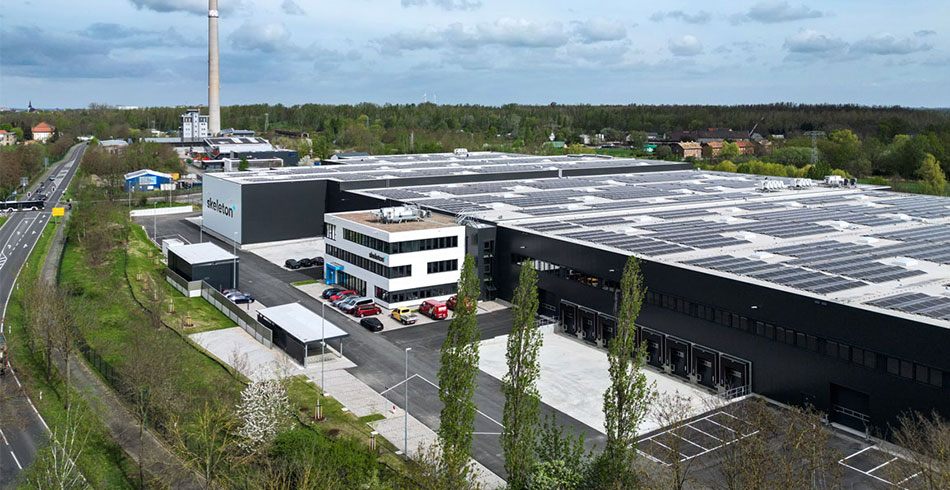
Global confidence in this technology is rising fast, and the further we push into a more electrified society, demand is set to take off. Estonia’s Skeleton Technologies has just opened a new €220 million (AUD$380 million) supercapacitor superfactory in Germany—a strong signal of where investment is heading.
Now, a new generation of advanced supercapacitors is being developed that could address many of these challenges and make them an even more widespread technology.
Redefining the power-energy trade-off
New graphene-based materials can transform what supercapacitors can do. In our recent research, we discovered a unique new graphene derivative with curved crystals. Because charge accumulation is so efficient inside these graphene crystals, we were able to attain five to 10 times more energy density. Most importantly, these curved crystallites enable ions to move really quickly, unleashing some of the highest-reported power densities. The best part is that these devices are really thin, meaning we can pack more energy and power in a smaller space.
But we are not alone. It’s a very exciting time for innovation, and there’s a lot of great work all around the world uncovering fundamental science and pushing the boundaries of performance. Although under-appreciated until recently, supercapacitors are now on the brink of becoming an essential technology, promising faster, cheaper and longer-lasting energy storage.
Related article: Engineers achieve record performance in zinc–air batteries
Australia’s opportunity
Australia all the right ingredients and a genuine opportunity to lead in this field by leveraging our mineral wealth, world-class research institutions and high-value intellectual property. We are uniquely positioned to succeed, and yet, we invest far too little in turning breakthroughs into commercial realities. We have one of the lowest R&D spending of any OECD country, and we’re on track to become dead last in a few years. We should treat innovation and sovereign manufacturing as national priorities, not as afterthoughts, or we risk becoming customers of technologies we could be selling to the world.