What is quantum computing and how can it help drive the renewables transition here in Australia? Energy Source and Distribution chats to PsiQuantum chief technical director Geoff Pryde to find out.
Geoff, can you give us a brief introduction to PsiQuantum?
PsiQuantum is a company whose singular aim is to build the world’s first useful quantum computer using silicon photonics technology optimised for quantum performance. Its CEO and co-founder, Jeremy O’Brien, is Australian and trained and worked in Australia, as did one of the other co-founders, Terry Rudolph. Key early work in photonic quantum computing was done in Australia by Jeremy, Terry, myself, and a host of other researchers—indeed much of it in Queensland. Australia is a quantum computing powerhouse, publishing more scientific papers per capita in the field than anywhere else in the world, and training great talent in the field. It was both really exciting and quite fitting, therefore, when the Queensland and Australian governments partnered with PsiQuantum in 2024, as we work towards building the first commercially useful quantum supercomputer in Brisbane.
Related article: New funding to boost Australia’s quantum future
What is quantum computing, and what are its commercial applications?
A quantum computer operates using principles fundamentally different from any kind of computer that exists today. (It’s called quantum because it harnesses quantum mechanics—essentially the physics of single particles like the photons—light particles—we use, or atoms or electrons.) This enables it to solve complex problems in chemistry, maths, and physics that are forever unsolvable by conventional computers. As a result, quantum computers have the potential to revolutionise the development of sustainable energy solutions, new life-saving drugs, novel materials, industrial chemicals, and to enable many other complex scientific and engineering breakthroughs—unlocking innovations that would otherwise remain out of reach.
How can PsiQuantum’s quantum computer help progress the renewables transition?
Innovation is key to bringing online new technologies to enhance renewable energy production and storage, decarbonise existing industries, and find novel solutions to the climate crisis. PsiQuantum’s machine will provide transformative capabilities to design, compute, and simulate new materials, chemicals and catalysts, reaction pathways, processes, and hardware. This is likely to impact everything from the design of more efficient and cost-effective solar cells, to the hydrogen industry, minerals extraction, battery design, and perhaps even the design and maintenance of plant. The quantum computing advantage is often in microscopic or fundamental processes, but these can flow through to be the basis of positive day-to-day consumer impacts, such as step changes in the performance, cost, and environmental benefit of energy generation and storage.
How does Australia have an advantage in this sector?
Australia has a track record of fantastic breakthroughs and opportunities in the renewables sector, and the sunlight and other resources to lead the energy transformation. However, there’s a threat that the country might not fully capitalise on its opportunities—competition is often a manufacturing challenge where costs and regulations dominate. But quantum computing could instead allow an innovation challenge, where new or transformative technological approaches open the door to an industry reset. Continued investment in quantum computing, and in how to harness it in industry, will help to position Australia as a global leader in technology, attracting investment and skilled talent from around the country and overseas, and bolstering sovereign capability. With the first commercially-useful quantum computer set to be built in Australia, our local quantum computing expertise and workforce, and our strong resources industry, and discipline experts in energy sector science and technology, there’s an opportunity to be seized.
What’s involved in building the world’s first commercial quantum computer?
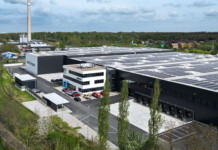
A useful quantum computer will require at least a million qubits—quantum bits—and the ability to use them for computation in a controlled way, minimising errors. In turn, that requires building, connecting, cooling, and operating lots of high-performance hardware. PsiQuantum has chosen a silicon photonics approach—using single particles of light generated, manipulated, and measured in waveguides (optical wires) on a silicon chip. We recently announced our Omega platform, a feature-complete chipset manufactured in partnership with GlobalFoundries, a tier-1 semiconductor foundry that makes the kinds of chips in high-end electronics. That means that we can manufacture high-quality parts in the volumes we need while maintaing the performance we require. These will be connected using optical fibre, similar to how we transmit data optically now, but with single photons instead of bright light. Some of our components needs to be cooled to the temperature of deep space, and we’ve ordered a cryoplant—a large refrigeration plant for these cold temperatures—to facilitate that. Despite the complexity, this pathway has been designed to make the system scalable to a million qubits, and upgradeable beyond that. The facility will look something like a data centre—several really large buildings with modular hardware inside.
Related article: “Giant leap”: UQ researchers set new solar cell world record
How will Australian companies be able to utilise it when completed?
We’re encouraging companies to get on board with quantum computers now to avoid playing catchup like we’ve seen with other new technologies. Much of the world was late to understand what opportunities semiconductors would bring and the importance of their manufacturing location, but we appear to be getting ahead this time. Governments are creating quantum strategies and putting resources behind the quantum race. By asking energy and resources companies to engage with us now, we can understand their needs and challenges and identify specific use cases in partnership with them as we bring the quantum technology to scale. Once operational, the demand will be huge and supply limited. Working ahead of time to have key technology development problems ready to simulate will allow companies to hit the ground running, and capitalise on the transformative benefits that this technology is expected to bring.
The PsiQuantum story and how it relates to applications in energy, minerals, and mining will be unpacked in a talk Geoff is giving at the Global Resources Innovation Expo (GRX25) in Brisbane from 20-22 May 2025. For more information and to register, visit www.grx.au