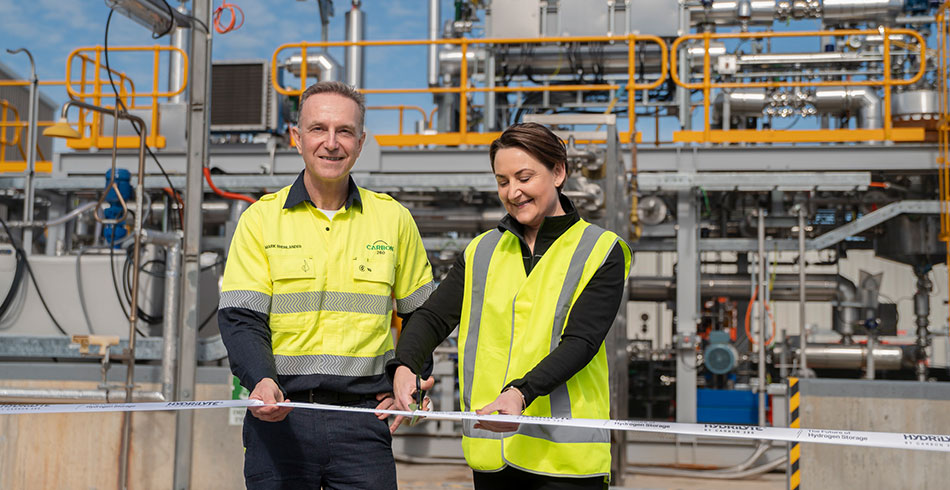
Australian startup Carbon280 has unveiled its new Hydrilite Technology Pilot Plant for safe and cost-effective hydrogen storage and transportation in Kwinana, Western Australia.
Carbon280 raised over $16 million to accelerate its innovative liquid hydrogen storage solution, Hydrilyte. The pilot and laboratory facilities were funded through a $10.6 million seed investment led by Woodside Energy, with support from UK-based renewable energy company Hive Energy and a Singaporean family office, alongside a forecast $5.5 million in R&D rebates from the Australian Government.
Related article: Australia needs to get smarter with green hydrogen
Australia’s hydrogen ambitions face growing headwinds, with rising costs, technical complexity, and a number of high-profile projects stalled or cancelled. Carbon280 says its Hydrilyte Technology Pilot Plant—a 100kW TRL6 prototype—will prove the technology at an industrially relevant scale, delivering critical performance data for partners and investors.
A successful outcome will validate Carbon280’s technology, reducing the cost for existing hydrogen users, improving the economics and speed the implementation of future projects, including production of green iron, synthetic aviation fuels and methanol.
Hydrilyte technology addresses a major bottle neck in the hydrogen supply chain, enabling hydrogen to be stored safely at ambient temperature and pressure. This makes the storage and transport of hydrogen safer, more efficient and more economically viable.
“Hydrilyte solves one of the biggest challenges for the hydrogen industry—at scale,” Carbon280 founder and CEO Mark Rheinlander said.
“Rather than transporting a highly flammable gas you are storing and transporting a safe, low-cost liquid that stores hydrogen under ambient conditions. Low-cost and ease of handling will simplify and speed the implementation of hydrogen projects globally, enabling hydrogen use in applications and geographies with less sophisticated infrastructure.”
Hydrilyte’s ability to separate hydrogen from helium and store the hydrogen ready for transport gives it the potential to advance natural hydrogen projects in Australia and globally.
Natural hydrogen occurs mixed with other gasses that need to be separated. Helium is one of these gasses and very hard to separate from hydrogen because of their similar molecular size. Hydrilyte enables separation and storage, ready for transport, in a single step, facilitating the monetisation of both hydrogen and helium for natural hydrogen developers.
Related article: Uni to conduct world-leading hydrogen pipeline research
As a safe, pumpable liquid, the hydrogen-containing Hydrilyte can be stored and transported using existing liquid fuels infrastructure, including pipelines, tankers, and ships. More broadly, the technology has the potential to deliver a hydrogen transportation method that costs less, is inherently safe, energy efficient and ultra-scalable.
“Natural hydrogen in combination with Hydrilyte will be gamechanging for the use of hydrogen across all industries, including energy, by slashing costs and simplifying handling,” Rheinlander said.