By Steve Wilson, Design Director & Capability Leader, Power Generation, Aurecon
For years, new solar was sold as ‘battery ready’: keep the space, preserve the option, add storage later if the economics stacked up. That framing has aged out. AEMO’s latest connection data shows hybrid solar-plus-battery projects now make up half of solar in the connection queue—up from a quarter a year earlier—and more than half of those hybrids include grid-forming batteries.
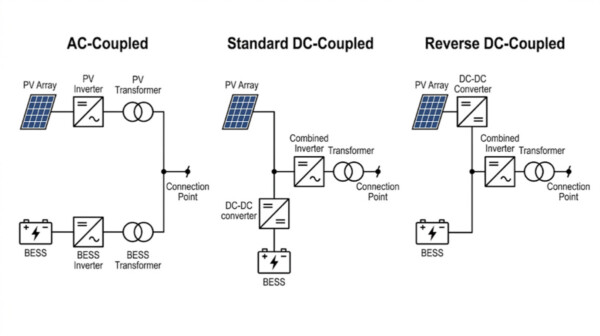
This matters because the system those projects are entering is more inverter-based, less forgiving, and more reliant on assets that can create hosting capacity and support stability. In that environment, a hybrid plant is no longer just a hedge against curtailment or weak prices. It is a flexibility and grid-supporting asset. This also means the choice in architecture—between AC, standard DC and reverse DC coupling is no longer a layout decision. It is a whole-of-project decision about connection capability, operational flexibility, revenue potential and risk.
Related article: Negotiating the two-way grid
The wrong first question
The wrong opening question is whether a hybrid plant should be AC- or DC-coupled. That is a technology label, not a project objective. The better question is which architecture creates the strongest whole-of-project outcome for the role the hybrid needs to play.
More often than not, the challenge is not singular but layered. A hybrid may need to recover clipped solar and shift bulk day-time generation to more valuable intervals; make better use of a scarce point of interconnection, or of Renewable Energy Zone capacity increasingly structured as a coordinated generation, storage and network platform; firm revenue through a merchant service stack; and, increasingly, support a weak or constrained node. Which of these drivers matters most will vary by project, but in practice it is usually their combination—and the way they interact—that shapes the most credible architecture response.
The system strength challenge has become harder to treat as secondary. Under the National Electricity Rules’ system strength framework, proponents either remediate or elect to pay the system strength charge. With grid-forming inverters able to materially alleviate that, they are looking less like an optional enhancement and more like part of the design brief for hybrids—not just for standalone batteries, but across hybrid configurations more broadly. In that context, the real divide is no longer AC versus DC. It is whether the plant remains, in essence, a grid-following renewable project with storage attached, or becomes a hybrid that can materially improve behaviour at the connection point.
AC-coupling: still the reference case
AC-coupled hybrids remain the practical reference case for good reason. In this architecture, the renewable plant and the battery are essentially neighbours—separate inverter systems, separate transformers, meeting on the AC side before the connection point. Standard equipment. Familiar integration pathways. At a system level, it still behaves much like two coordinated but independent assets.
For wind and existing solar, AC coupling is the practical path to hybrid—storage can be added without replacing the PV inverter or reworking the DC side of the plant.
Its other strength is operational freedom. The battery can charge from the grid, dispatch independently of renewable output, and stack merchant and ancillary-service value with relatively clean separation. Add grid-forming capability and AC-coupling stops looking merely conservative. It becomes a credible way to strengthen behaviour at the connection point itself. It remains the clearest route to retrofitability, dispatch flexibility, and lower connection risk where grid support capability is a priority.
Where DC-coupling is genuinely compelling
DC-coupling does also deserve serious consideration—not as a universal upgrade, but as a purpose-built architecture for new solar hybrids in which the battery’s primary value proposition is to capture solar output, reshape its delivery profile, and shift more of it into later intervals. The question then becomes which DC-coupling variant is best aligned to the task.
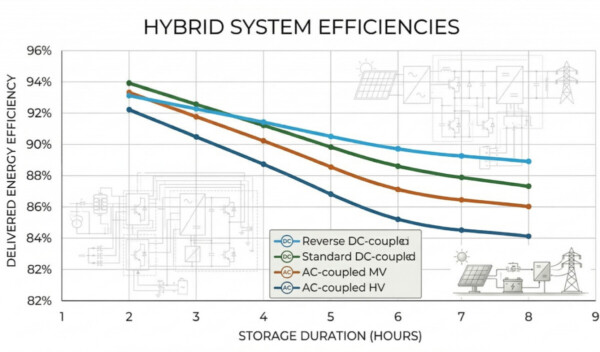
The performance differences are real, but specific. Standard DC-coupling is stronger when the plant is still optimised primarily around direct solar production, with a smaller battery playing a supporting role in capturing excess generation and shifting it into later intervals—preserving a strong direct PV-to-grid path while providing a solar-to-battery route. Reverse DC-coupling has a stronger case for longer duration batteries where a larger share of solar is routed through storage, making battery throughput a more central part of the equation. With typical design parameters that shift becomes visible at around 3.6 hours of battery duration, where reverse DC-coupling begins to outperform standard DC-coupling on an overall delivered energy basis.
Capturing clipped solar is another benefit of DC-coupled hybridisation, but rarely the primary justification for the battery. The stronger case is whole-of-plant optimisation: better use of shared infrastructure, a more efficient solar-to-storage pathway, and a design philosophy that treats storage as part of the generation system rather than a separate add-on. On that view, DC-coupling is most compelling where the project is intentionally designed to operate as one coordinated solar-plus-storage plant.
Inverter based grid-forming capability, once mainly the domain of a standalone BESS, is now reshaping the DC-coupling story as well. In reverse DC-coupled arrangements that use a BESS inverter, grid-forming is not a future possibility; it is a natural fit. Standard DC-coupled architectures are less mature on this front but should not be dismissed. Grid-forming capability is beginning to emerge in some of these arrangements as vendor offerings evolve. The test now is familiar: can these solutions establish enough credibility in the connection process to move from interesting to bankable?
Start with the project objective, not the wiring diagram
The real trade-off is not between the cheapest single-line diagram and the neatest architecture. It is between different ways of creating whole-of-project value: at the connection point, across the revenue stack, and over the asset’s risk and compliance life. For wind and retrofit solar, the AC-coupled pathway is clear. For new-build solar hybrids, DC-coupled options deserve harder scrutiny where shared infrastructure cost savings and solar-to-storage efficiency are the dominant drivers.
That shifts the evaluation lens. How much clipped or curtailed energy can be recovered? How much value does independent battery dispatch add to the revenue stack? How can system strength charge exposure be mitigated most cost-effectively? And how do lifetime losses, augmentation flexibility and compliance risk differ across architectures? In a system where central support cannot be assumed at every location, the best hybrid is the one whose architecture is most closely aligned to the needs of the connection point, the service stack and the project’s future risk profile.
Related article: Renewables over 50%, wholesale prices down… Is the energy transition succeeding?
The next wave: hybrid projects better aligned to deliver whole-of-project value
The next shift is less about crowning a winning architecture and more about changing how hybrids are framed. Coupling choice is still often treated as a downstream engineering decision. Increasingly, it needs to be addressed much earlier in project development. It shapes what the plant can deliver at the connection point, how flexibly it can operate, and how exposed it is to compliance costs.
That reframing lands differently depending on where you sit. For developers, it changes the design brief at the front end. For networks and planners, it suggests hybrids should be evaluated less as simple pairings of generation and storage, and more by the quality of grid behaviour they contribute at the node. For investors, it means architecture is not just a capex choice, but part of the wider value and risk equation. And for OEMs, the direction of travel is becoming hard to ignore: grid-forming capability is moving steadily towards the centre of credible hybrid design.
The projects most likely to distinguish themselves over the next few years may therefore not be the cheapest, nor the simplest, but those whose architectures are better aligned to deliver whole-of-project value – across connection capability, operational flexibility, revenue potential and long-term risk.