A first in green hydrogen reactor technology has been launched at the University of Adelaide’s Roseworthy campus by Australian startup Sparc Hydrogen—a joint venture between Fortescue, Sparc Technologies and the University of Adelaide.
The Sparc Hydrogen Advanced Research Pilot (SHARP) is a test bed for photocatalytic water splitting (PWS)—a process which harnesses the sun’s energy to extract (green) hydrogen from water, without the need for electrolysers powered by electricity. It’s a potential game-changer in the global effort to deliver scalable, low-cost, renewable hydrogen.
Related article: Beam us down: CSIRO breakthrough to fuel green hydrogen
SHARP will accelerate the development of Sparc Hydrogen’s patented PWS reactor technology and will enable realworld evaluation of PWS catalysts being developed globally. In bringing together the world’s best reactor and catalyst technologies, and invaluable operational experience, SHARP represents a huge step forward in solar hydrogen commercialisation.
PWS is often referred to as direct solar-to-hydrogen technology as it avoids the need to convert solar energy into electricity to split water via electrolysis.
In photocatalysis, the sun’s energy is directed onto a highly specialised photocatalyst material, which forms reactive sites that splits water into hydrogen and oxygen without electrolysis.
Despite decades of research and notable advancements, the efficiency of PWS remains a key challenge to reaching commercialisation. The SHARP pilot plant aims to improve the economics of producing green hydrogen using PWS through driving increased efficiencies within modular and scalable concentrated solar infrastructure.
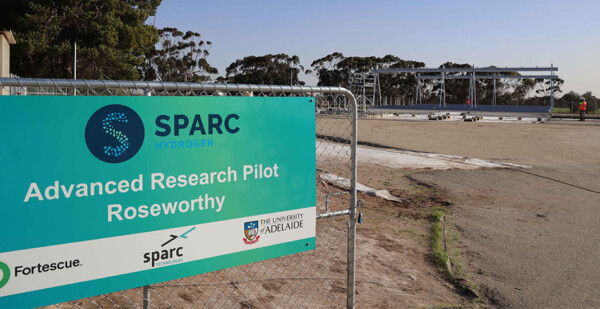
In the lead up to commissioning of the plant, front-end engineering and design was undertaken by leading global engineering and commercial service provider Incitias, while Sparc Hydrogen’s photocatalytic water splitting reactor, which is being commissioned using photocatalysts developed by Shinshu University in Japan, was developed at the University of Adelaide’s School of Physics, Chemistry and Earth Sciences.
Professor Greg Metha is lead researcher and inventor at Sparc Hydrogen and acting director at the university’s Centre for Energy Technology.
“The SHARP plant at the University of Adelaide’s Roseworthy campus will allow us to independently and concurrently test different reactor designs and photocatalyst materials,” he said.
Related article: Human urine and wastewater to boost green hydrogen
“This next-generation photocatalytic water splitting technology has major advantages over electrolysis as it offers the potential to produce low cost, scalable green hydrogen and heat without significant electricity use.”
Fortescue director of R&D Michael Dolan commented, “At Fortescue, we are investing in a suite of technologies that can accelerate decarbonisation at an industrial scale.
“The SHARP pilot demonstrates the power of partnership in pushing the boundaries of green hydrogen innovation.”