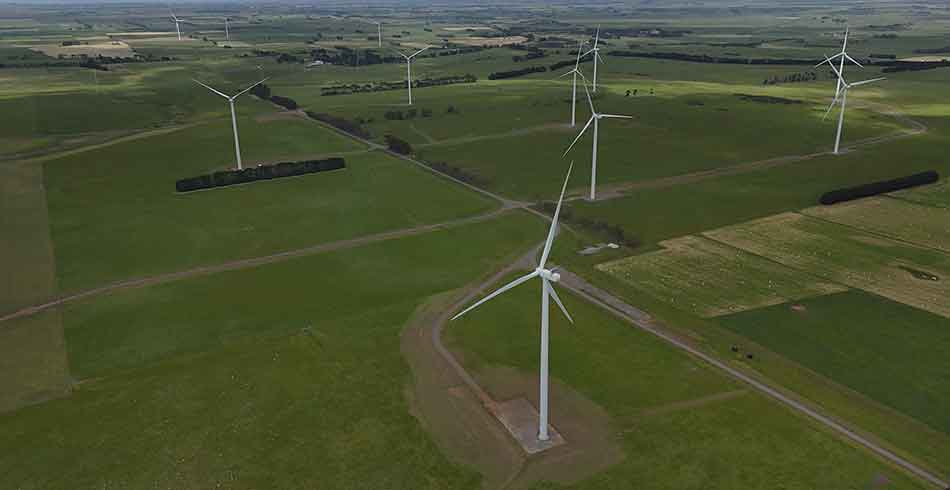
Global Power Generation (GPG) has announced that its 97MW Hawkesdale Wind Farm, backed by online retail giant Amazon, has reached commercial operation.
Located 30km north-west of Warrnambool in Victoria, Hawkesdale Wind Farm comprises of 23 turbines and is expected to generate 337,000MWh of carbon-free energy annually— enough to power the equivalent of an estimated 67,000 Australian homes each year.
Related article: Amazon meets 100% renewables goal seven years early
The Hawkesdale project is the first utility-scale renewable energy project enabled by Amazon in Victoria. Amazon is the top corporate purchaser of renewable energy globally, according to Bloomberg NEF.
Amazon Australia director of public policy Michael Cooley said, “Amazon is committed to driving the carbon-free energy transition forward, both to advance our Climate Pledge goals, and support Australia’s transition to more sustainable energy sources.
“As global energy demands continue to grow, we’re focused on bringing new sources of solar and wind energy to the country, which will help support our operations, as well as the communities where our customers live and work. That’s why we’ve invested in more than 600 solar and wind projects globally and have been named the top corporate purchaser of renewable energy globally for the fifth year in a row.”
GPG Australia head of development APAC Shahmir Mohajerani said, “We are thrilled to reach this significant milestone with the Hawkesdale Wind Farm reaching its operational phase.
Related article: Amazon partners with startup to pilot new redox flow battery
“This project, in collaboration with Amazon, exemplifies our mutual commitment to advancing renewable energy development in Australia. By harnessing the wind resources in Victoria, we are not only producing clean energy but also helping the state achieve its ambitious renewable energy targets, while creating new economic opportunities for the local community.”
A standout feature of the Hawkesdale Wind Farm project is the innovative use of helicopters for stringing transmission lines. This method was chosen to ensure the project respected native vegetation and cultural heritage sites. The technique also proved to be time-efficient and cost-effective, further demonstrating GPG and Amazon’s commitment to community-conscious project development.